A step up and step down autotransformer is a type of electrical transformer that uses a single continuous winding to either increase (step up) or decrease (step down) voltage between its input and output terminals. Unlike conventional dual-winding transformers, an autotransformer shares part of its winding between the primary and secondary circuits, making it more compact, lighter, and more efficient for applications where electrical isolation is not required.
Understanding how autotransformers step voltage up or down is essential for electrical engineers, technicians, and anyone involved in power distribution, industrial equipment, or electrical testing. This guide explains the working principle, key differences between step-up and step-down configurations, advantages, common applications, and safety considerations.
ما هو المحول الذاتي؟
An autotransformer is a transformer with a single winding wound around a laminated core. The term “auto” comes from the Greek word for “self,” reflecting that the winding acts upon itself. In this design, a portion of the same winding serves as both the primary and secondary coil. The winding has at least three terminals: two end terminals and one or more intermediate tap points.
Because the primary and secondary circuits share part of the same conductive path, power transfer occurs through both الحث الكهرومغناطيسي و direct electrical conduction. This dual mechanism is what gives the autotransformer its efficiency advantage over a conventional two-winding transformer of equivalent rating.
Step Up and Step Down Autotransformer: How They Work
The classification of an autotransformer as تكثيف الجهود أو التنحي depends entirely on how the input and output are connected across the shared winding. The same physical device can often function in either mode by changing the connection arrangement.
الميزة
Step Up Autotransformer
Step Down Autotransformer
توصيل المدخلات
على امتداد جزء من الطريق المتعرج
على طول المسار المتعرج بأكمله
وصلة الإخراج
على طول المسار المتعرج بأكمله
على امتداد جزء من الطريق المتعرج
نسبة الجهد
Vout > Vin
Vout < Vin
Turn ratio (N2/N1)
أكبر من 1
أقل من 1
Common example
120 V input to 230 V output
230 V input to 120 V output
How a Step Up Autotransformer Works
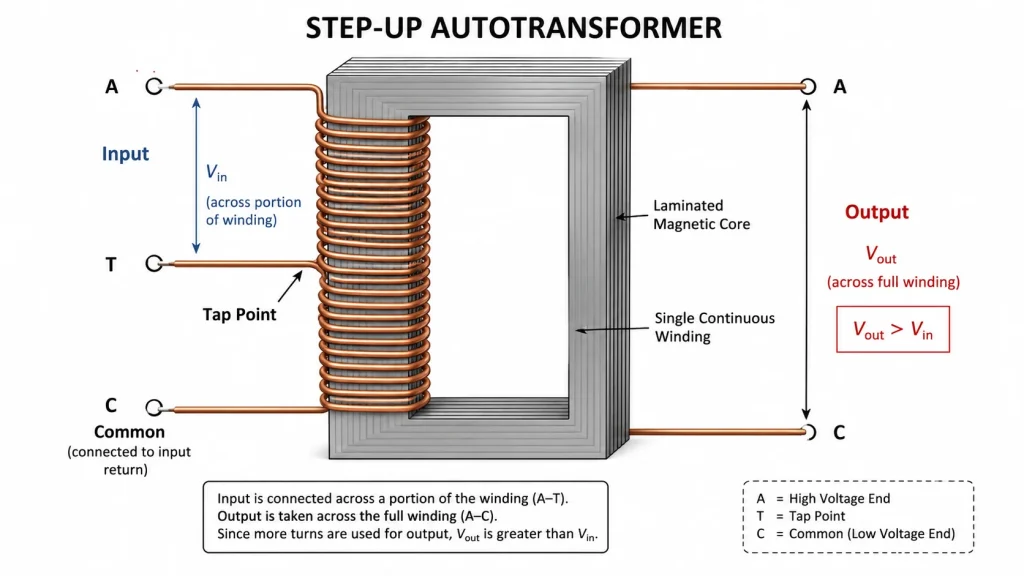
في محول ذاتي رفع الجهد, the input voltage is applied across a portion of the winding, and the output is taken across the entire winding. Since the output taps span more turns than the input section, the output voltage is higher than the input voltage. The voltage ratio follows the same turn-ratio principle used in conventional transformers:
Vout / Vin = Ntotal / Ninput
For example, if an autotransformer has 200 turns total and the input is applied across 100 turns, the output voltage will be twice the input voltage. If you apply 120 V across the lower half, the full winding delivers 240 V.
How a Step Down Autotransformer Works
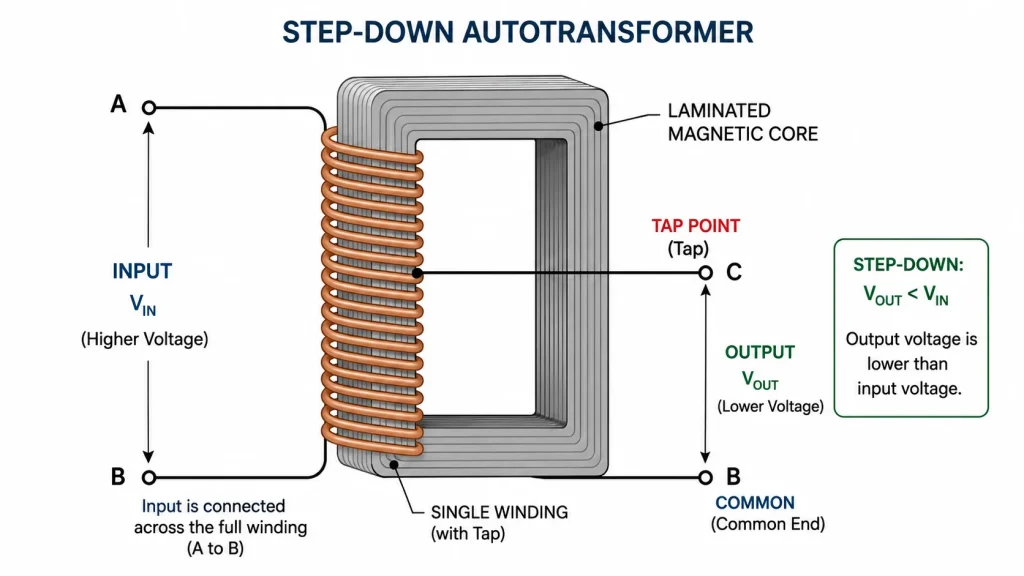
في محول ذاتي خافض الجهد, the input voltage is applied across the entire winding, and the output is taken from a tap point along the winding. Since the output section has fewer turns than the input section, the voltage is reduced.
For example, if the full winding has 200 turns with 230 V applied, a tap at the 100-turn point delivers 115 V. This configuration is widely used in voltage converters, motor starters, and distribution voltage regulation.
المحول الذاتي مقابل المحول التقليدي
Choosing between an autotransformer and a conventional dual-winding transformer depends on the specific application requirements. The table below highlights the key differences.
المعيار
المحول التلقائي
المحول التقليدي
ترتيب اللف
لف واحد متواصل
Two separate windings (primary & secondary)
العزل الكهربائي
No isolation between input and output
Galvanic isolation provided
الحجم والوزن
Smaller and lighter (less copper and core material)
Larger and heavier for the same rating
التكلفة
انخفاض تكاليف المواد والتصنيع
ارتفاع التكلفة
الكفاءة
Higher (lower copper and core losses)
Lower for equivalent rating
Short-circuit impedance
Lower (produces higher fault currents)
Higher (limits fault current better)
Best voltage ratio range
Up to approximately 3:1
أي نسبة، بما في ذلك النسب المرتفعة جدًّا في الاتجاهين الصعودي أو الهبوطي
السلامة
Less safe (no isolation; winding failure can expose output to full input voltage)
Safer (isolated circuits)
Key Advantages of Step Up and Step Down Autotransformers
حجم صغير ووزن أقل. Because only one winding carries the power, the autotransformer requires less copper and a smaller core, making it significantly lighter and smaller than an equivalent two-winding transformer.
كفاءة أعلى. Reduced copper losses and lower core losses mean autotransformers operate with better energy efficiency, typically achieving 98% or higher in power applications.
تكلفة أقل. Less material translates directly into lower manufacturing costs, which benefits projects where budget is a constraint.
Lower leakage reactance. The shared winding design results in lower leakage inductance, which improves voltage regulation under varying load conditions.
Higher VA rating per unit size. For the same physical size, an autotransformer can handle a higher volt-ampere rating than a conventional transformer.
Smooth voltage adjustment. Variable autotransformers with sliding contacts allow continuously adjustable output voltage, useful in testing and laboratory environments.
Common Applications
Power Transmission and Distribution
Autotransformers are widely used to interconnect power systems operating at different voltage levels, such as linking 132 kV and 66 kV transmission networks. They also serve as voltage regulators on long distribution lines, where tap-changing autotransformers compensate for voltage drop to maintain consistent supply at the customer end. For more power solutions, browse our product catalog.
Industrial Machinery and Motor Starting
In industrial settings, autotransformers adapt machinery built for one voltage standard to operate on another—for example, running 480 V equipment on a 600 V supply. Autotransformer starters are a proven method for soft-starting large induction motors, where reduced-voltage taps (typically at 50%, 65%, and 80%) limit inrush current during acceleration.
Voltage Conversion for Equipment
Step up and step down autotransformers serve as travel voltage converters, allowing 230 V appliances to operate on 120 V mains and vice versa. They are also built into audio systems for impedance matching between components and into railway electrification systems to extend feeder distances on 25 kV AC networks.
Laboratory and Testing Equipment
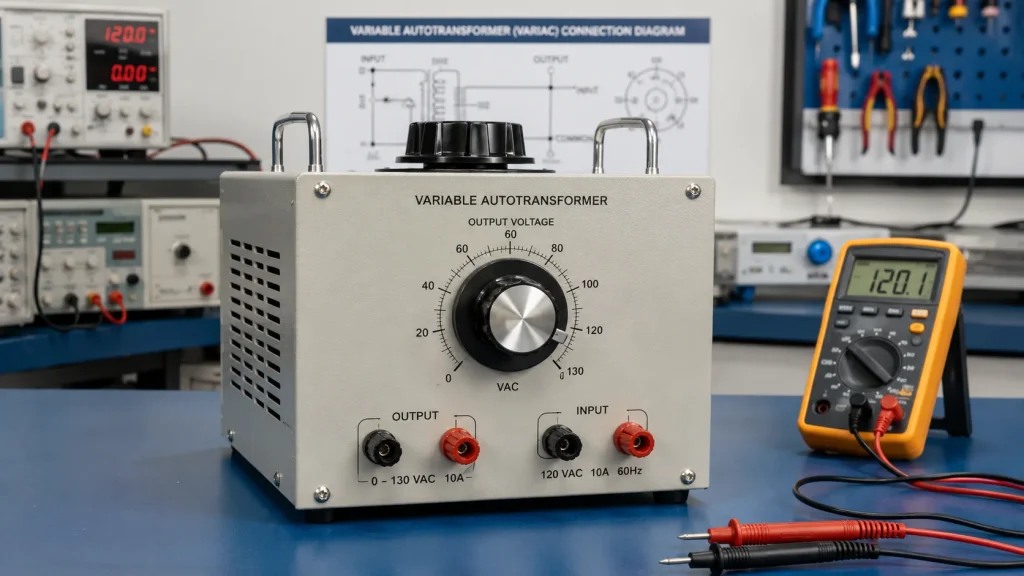
Variable autotransformers, commonly known by the trade name فارياك, provide continuously adjustable AC voltage from zero to above line voltage. These are essential in repair shops, R&D labs, and production testing where equipment must be tested across its full specified voltage range.
Limitations and Safety Considerations
لا يوجد عزل كهربائي. The input and output circuits are directly connected through the shared winding. Any fault or surge on one side appears on the other, creating a shock and equipment-damage risk.
خطر تعطل الملف. If the common section of the winding breaks, the full input voltage can appear at the output terminals under light load conditions. This is a critical safety hazard in consumer-facing applications.
نسبة الجهد المحدودة. Autotransformers are most economical for voltage ratios up to about 3:1. Beyond this range, the cost and size advantage diminishes, and a conventional transformer becomes the better choice.
تيارات عطل أعلى. The lower leakage impedance produces higher short-circuit currents compared to a dual-winding transformer, requiring careful protection coordination.
Not for DC applications. مثل جميع المحولات التي تعتمد على الحث الكهرومغناطيسي، لا يمكن للمحولات الذاتية رفع أو خفض جهد التيار المستمر.
A step up and step down autotransformer is a versatile, efficient, and cost-effective alternative to conventional dual-winding transformers for applications where electrical isolation is not required. Its single-winding design delivers higher efficiency in a smaller package, making it the preferred choice for power system interconnection, industrial motor control, voltage conversion, and laboratory testing.
When selecting between an autotransformer and a conventional transformer, the key decision factor is whether your application demands galvanic isolation. If isolation is not mandatory and the voltage ratio is within the 3:1 range, an autotransformer will almost always offer better efficiency, lower cost, and reduced footprint.
For help choosing the right autotransformer for your specific voltage requirements, contact our team to discuss your application.
This comparison is one of many technical resources we publish to support smarter component selection. Whether you’re specifying transformers for a control panel, troubleshooting voltage conversion in a retrofit project, or sourcing custom magnetics for a new product line — you’ll find detailed product guides, application notes, and datasheets to keep your project moving. Visit our home to explore our complete transformer catalog and the latest engineering content.
الأسئلة الشائعة
Can an autotransformer be used to both step up and step down voltage?
Yes. The same autotransformer can function as either step up or step down depending on how the input and output connections are arranged. Simply swap which terminals serve as input and which as output. However, in practice, losses mean the device is slightly more efficient in the direction it was designed for.
What is the maximum step-up ratio for an autotransformer?
Most practical autotransformers operate at a voltage ratio of up to 3:1. Beyond this, the size and cost advantages over a conventional transformer decrease, and the voltage ratio no longer justifies the loss of electrical isolation.
Why does an autotransformer not provide electrical isolation?
Because the primary and secondary circuits share the same physical winding and are electrically connected. There is no separate secondary coil, so current can flow directly between input and output. A conventional transformer uses two magnetically coupled but electrically separate coils to achieve galvanic isolation.
Where are step up and step down autotransformers used most commonly?
The most common applications include power system interconnection between different voltage levels, industrial motor starters, voltage converters for international travel, audio impedance matching, laboratory variable AC supplies, and railway traction power distribution.
What happens if an autotransformer winding fails?
If the common section of the winding opens (breaks), the transformer essentially becomes an inductor in series with the load. Under light load, this can result in nearly full input voltage appearing at the output, potentially damaging connected equipment. This is why autotransformers are not recommended for applications where isolation is a safety requirement.
Are autotransformers more efficient than conventional transformers?
Yes, for the same power rating and voltage ratio, autotransformers achieve higher efficiency because they have lower copper losses (less winding material) and lower core losses (smaller core). Power autotransformers commonly reach efficiencies above 98%.
محول من 230 فولت إلى 110 فولت مخصص لهولندا: معيار NEN 1010، وقواعد قاطع التيار الأرضي (30 مللي أمبير)، والفروق بين قاطع التيار الأرضي اليدوي (aardlekschakelaar) وقاطع التيار الأرضي الأوتوماتيكي (aardlekautomaat)، والتأريض الثانوي.