A autotransformador elevador e redutor é um tipo de transformador elétrico que utiliza um único enrolamento contínuo para aumentar (elevar) ou diminuir (reduzir) a tensão entre seus terminais de entrada e saída. Ao contrário dos transformadores convencionais de enrolamento duplo, um autotransformador compartilha parte de seu enrolamento entre os circuitos primário e secundário, tornando-o mais compacto, mais leve e mais eficiente para aplicações nas quais não é necessário isolamento elétrico.
Compreender como os autotransformadores aumentam ou reduzem a tensão é essencial para engenheiros elétricos, técnicos e qualquer pessoa envolvida na distribuição de energia, em equipamentos industriais ou em testes elétricos. Este guia explica o princípio de funcionamento, as principais diferenças entre as configurações elevadoras e redutoras, as vantagens, as aplicações comuns e as considerações de segurança.
O que é um autotransformador?
Um autotransformador é um transformador com um único enrolamento enrolado em torno de um núcleo laminado. O termo “auto” deriva da palavra grega que significa “auto”, refletindo o fato de que o enrolamento atua sobre si mesmo. Nesse projeto, uma parte do mesmo enrolamento funciona tanto como bobina primária quanto como bobina secundária. O enrolamento possui pelo menos três terminais: dois terminais nas extremidades e um ou mais pontos de derivação intermediários.
Como os circuitos primário e secundário compartilham parte do mesmo caminho condutor, a transferência de energia ocorre por meio de ambos indução eletromagnética e condução elétrica direta. Esse mecanismo duplo é o que confere ao autotransformador sua vantagem em termos de eficiência em relação a um transformador convencional de dois enrolamentos com potência nominal equivalente.
Autotransformadores elevadores e redutores: como funcionam
A classificação de um autotransformador como dar um passo à frente ou renunciar depende inteiramente de como a entrada e a saída estão conectadas no enrolamento compartilhado. Muitas vezes, o mesmo dispositivo físico pode funcionar em qualquer um dos modos, bastando alterar a disposição das conexões.
Recurso
Autotransformador elevador
Autotransformador redutor
Conexão de entrada
Ao longo de um trecho da sinuosa
Ao longo de toda a curva
Conexão de saída
Ao longo de toda a curva
Ao longo de um trecho da sinuosa
Relação de tensão
Vout > Vin
Vout < Vin
Relação de rotação (N2/N1)
Maior que 1
Menos de 1
Exemplo comum
Entrada de 120 V para saída de 230 V
Entrada de 230 V para saída de 120 V
Como funciona um autotransformador elevador de tensão
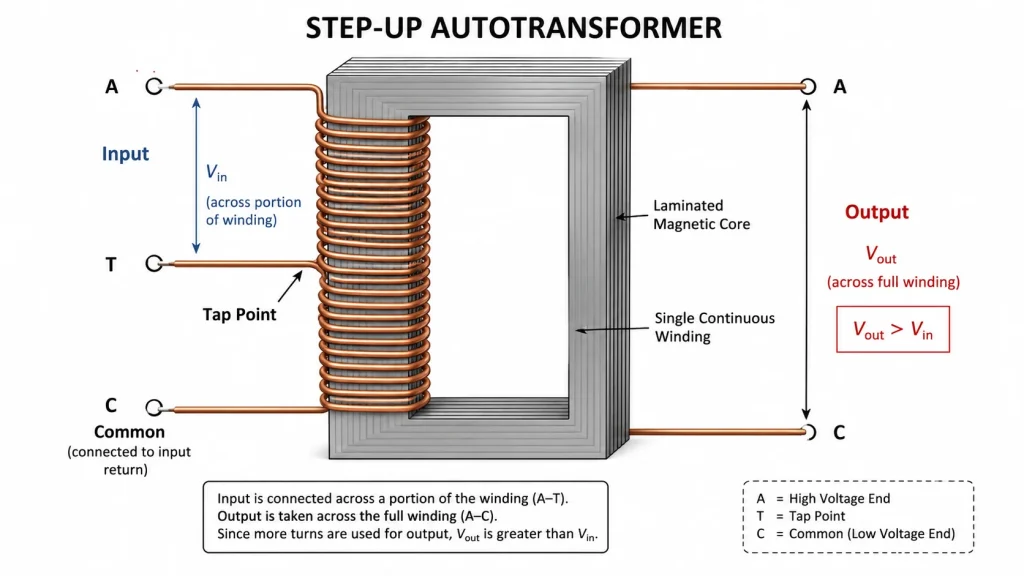
Em um autotransformador elevador, a tensão de entrada é aplicada em uma parte do enrolamento, e a tensão de saída é captada em todo o enrolamento. Como as derivações de saída abrangem mais espiras do que a seção de entrada, a tensão de saída é maior do que a tensão de entrada. A relação de tensão segue o mesmo princípio de relação de espiras utilizado nos transformadores convencionais:
Vout / Vin = Ntotal / Ninput
Por exemplo, se um autotransformador tiver 200 espiras no total e a tensão de entrada for aplicada em 100 espiras, a tensão de saída será o dobro da tensão de entrada. Se você aplicar 120 V na metade inferior, o enrolamento completo fornecerá 240 V.
Como funciona um autotransformador redutor
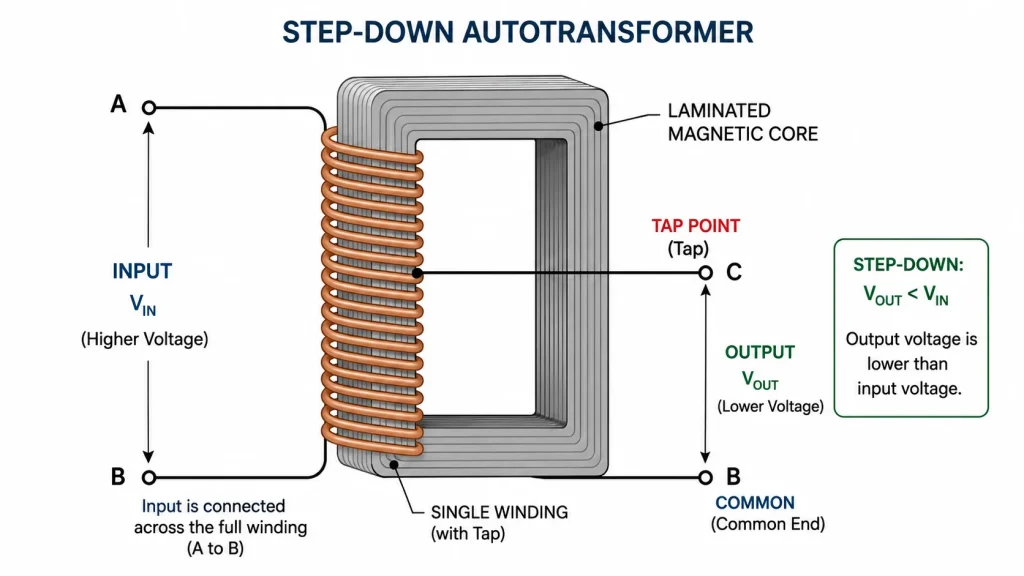
Em um autotransformador redutor, a tensão de entrada é aplicada em todo o enrolamento, e a saída é obtida em um ponto de derivação ao longo do enrolamento. Como a seção de saída possui menos espiras do que a seção de entrada, a tensão é reduzida.
Por exemplo, se o enrolamento completo tiver 200 espiras com 230 V aplicados, uma derivação no ponto de 100 espiras fornece 115 V. Essa configuração é amplamente utilizada em conversores de tensão, acionadores de motor e regulação de tensão de distribuição.
Autotransformador x Transformador Convencional
A escolha entre um autotransformador e um transformador convencional de duplo enrolamento depende dos requisitos específicos da aplicação. A tabela abaixo destaca as principais diferenças.
Critério
Autotransformador
Transformador convencional
Disposição do enrolamento
Enrolamento único contínuo
Dois enrolamentos distintos (primário e secundário)
Isolamento elétrico
Não há isolamento entre a entrada e a saída
Isolamento galvânico garantido
Dimensões e peso
Menor e mais leve (menos cobre e material do núcleo)
Maior e mais pesado para a mesma classificação
Custo
Custos mais baixos de material e fabricação
Custo mais elevado
Eficiência
Mais alto (menores perdas por cobre e no núcleo)
Menor para classificação equivalente
Impedância de curto-circuito
Mais baixo (produz correntes de falha mais elevadas)
Mais alto (limita melhor a corrente de falha)
Melhor faixa de relação de tensão
Até aproximadamente 3:1
Qualquer relação, incluindo relações de aumento ou redução muito elevadas
Segurança
Menos seguro (sem isolamento; uma falha no enrolamento pode expor a saída à tensão total de entrada)
Mais seguro (circuitos isolados)
Principais vantagens dos autotransformadores elevadores e redutores
Tamanho compacto e peso reduzido. Como apenas um enrolamento conduz a energia, o autotransformador requer menos cobre e um núcleo menor, o que o torna significativamente mais leve e menor do que um transformador equivalente de dois enrolamentos.
Maior eficiência. A redução das perdas em cobre e das perdas no núcleo significa que os autotransformadores operam com maior eficiência energética, atingindo normalmente 98% ou mais em aplicações de potência.
Custo mais baixo. Menos material se traduz diretamente em custos de fabricação mais baixos, o que beneficia projetos em que o orçamento é uma restrição.
Reatância de fuga mais baixa. O projeto de enrolamento compartilhado resulta em menor indutância de fuga, o que melhora a regulação de tensão em condições de carga variáveis.
Maior classificação VA por unidade de tamanho. Para o mesmo tamanho físico, um autotransformador pode suportar uma potência nominal em volt-amperes maior do que um transformador convencional.
Ajuste suave da tensão. Autotransformadores variáveis com contatos deslizantes permitem o ajuste contínuo da tensão de saída, o que é útil em ambientes de teste e laboratoriais.
Aplicativos comuns
Transmissão e Distribuição de Energia Elétrica
Os autotransformadores são amplamente utilizados para interconectar sistemas de energia que operam em diferentes níveis de tensão, como na ligação entre redes de transmissão de 132 kV e 66 kV. Eles também atuam como reguladores de tensão em longas linhas de distribuição, onde os autotransformadores com comutação de derivações compensam a queda de tensão para manter um fornecimento constante no lado do consumidor. Para conhecer mais soluções de energia, consulte nosso catálogo de produtos.
Maquinário industrial e partida de motores
Em ambientes industriais, os autotransformadores adaptam máquinas projetadas para um padrão de tensão para que funcionem com outro — por exemplo, operando equipamentos de 480 V com uma alimentação de 600 V. Os acionadores com autotransformador são um método comprovado para partida suave de grandes motores de indução, onde as derivações de tensão reduzida (normalmente em 50%, 65% e 80%) limitam a corrente de irrupção durante a aceleração.
Conversão de tensão para equipamentos
Os autotransformadores elevadores e redutores funcionam como conversores de tensão para viagens, permitindo que aparelhos de 230 V funcionem em redes elétricas de 120 V e vice-versa. Eles também são incorporados em sistemas de áudio para a adaptação de impedância entre componentes e em sistemas de eletrificação ferroviária para ampliar as distâncias dos alimentadores em redes de 25 kV CA.
Equipamentos de laboratório e de ensaio
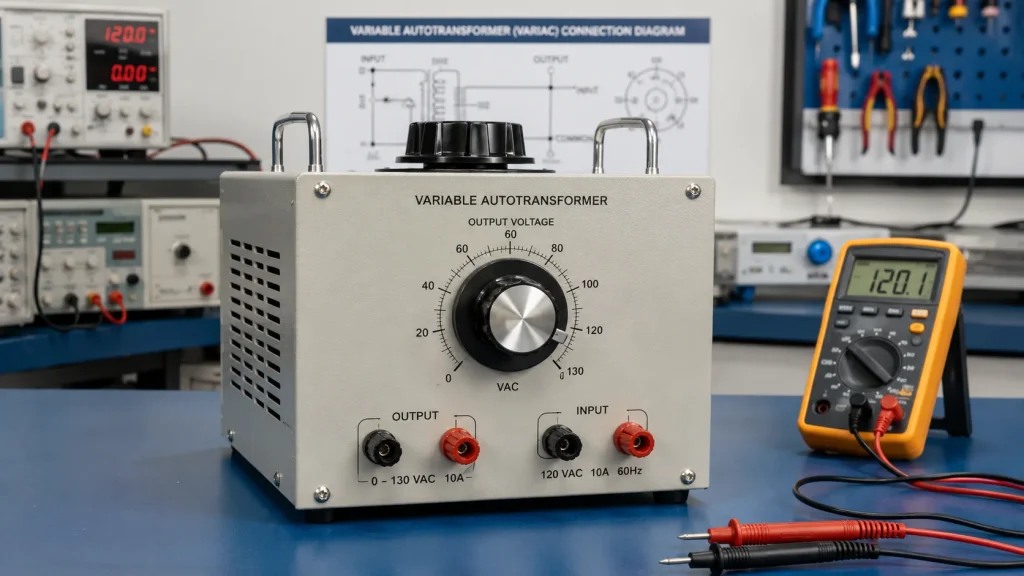
Autotransformadores variáveis, comumente conhecidos pelo nome comercial Variac, fornecem tensão CA continuamente ajustável, de zero até valores superiores à tensão da rede. São essenciais em oficinas de reparos, laboratórios de P&D e testes de produção, onde os equipamentos devem ser testados em toda a sua faixa de tensão especificada.
Limitações e considerações de segurança
Sem isolamento elétrico. Os circuitos de entrada e saída estão diretamente conectados por meio do enrolamento compartilhado. Qualquer falha ou pico de tensão em um dos lados se reflete no outro, criando risco de choque elétrico e danos ao equipamento.
Risco de falha no enrolamento. Se a seção comum do enrolamento se romper, a tensão de entrada total poderá aparecer nos terminais de saída em condições de carga leve. Isso representa um risco grave à segurança em aplicações voltadas para o consumidor.
Relação de tensão limitada. Os autotransformadores são mais econômicos para relações de tensão de até cerca de 3:1. Além dessa faixa, a vantagem em termos de custo e tamanho diminui, e um transformador convencional passa a ser a melhor opção.
Correntes de falha mais elevadas. A menor impedância de fuga gera correntes de curto-circuito mais elevadas em comparação com um transformador de duplo enrolamento, o que exige uma coordenação cuidadosa da proteção.
Não é indicado para aplicações com corrente contínua. Assim como todos os transformadores que funcionam com base na indução eletromagnética, os autotransformadores não podem aumentar nem reduzir a tensão contínua.
A autotransformador elevador e redutor é uma alternativa versátil, eficiente e econômica aos transformadores convencionais de duplo enrolamento para aplicações nas quais não é necessário isolamento elétrico. Seu design de enrolamento único oferece maior eficiência em um formato mais compacto, tornando-o a opção preferida para interconexão de sistemas de energia, controle de motores industriais, conversão de tensão e testes de laboratório.
Ao escolher entre um autotransformador e um transformador convencional, o principal fator a ser considerado é se a sua aplicação exige isolamento galvânico. Se o isolamento não for obrigatório e a relação de tensão estiver dentro da faixa de 3:1, um autotransformador quase sempre oferecerá maior eficiência, menor custo e menor espaço ocupado.
Para obter ajuda na escolha do autotransformador adequado às suas necessidades específicas de tensão, entre em contato conosco equipe para discutir sua candidatura.
Essa comparação é um dos muitos recursos técnicos que publicamos para auxiliar na seleção mais inteligente de componentes. Seja para especificar transformadores para um painel de controle, solucionar problemas de conversão de tensão em um projeto de modernização ou adquirir componentes magnéticos personalizados para uma nova linha de produtos — você encontrará guias detalhados de produtos, notas de aplicação e fichas técnicas para manter seu projeto em andamento. Visite nosso página inicial para conhecer nosso catálogo completo de transformadores e os conteúdos mais recentes sobre engenharia.
PERGUNTAS FREQUENTES
É possível usar um autotransformador tanto para aumentar quanto para reduzir a tensão?
Sim. O mesmo autotransformador pode funcionar tanto como elevador quanto como redutor de tensão, dependendo de como as conexões de entrada e saída são configuradas. Basta trocar quais terminais servem como entrada e quais como saída. No entanto, na prática, devido às perdas, o dispositivo é ligeiramente mais eficiente na direção para a qual foi projetado.
Qual é a relação de elevação máxima de um autotransformador?
A maioria dos autotransformadores práticos opera com uma relação de tensão de até 3:1. Acima desse valor, as vantagens em termos de tamanho e custo em relação a um transformador convencional diminuem, e a relação de tensão deixa de justificar a perda do isolamento elétrico.
Por que um autotransformador não proporciona isolamento elétrico?
Isso ocorre porque os circuitos primário e secundário compartilham o mesmo enrolamento físico e estão conectados eletricamente. Não há bobina secundária separada, de modo que a corrente pode fluir diretamente entre a entrada e a saída. Um transformador convencional utiliza duas bobinas acopladas magneticamente, mas separadas eletricamente, para obter isolamento galvânico.
Onde os autotransformadores elevadores e redutores são mais comumente utilizados?
As aplicações mais comuns incluem a interconexão de sistemas de energia entre diferentes níveis de tensão, acionadores de motores industriais, conversores de tensão para viagens internacionais, adaptação de impedância de áudio, fontes de alimentação de CA variáveis para laboratórios e distribuição de energia de tração ferroviária.
O que acontece se um enrolamento do autotransformador apresentar falha?
Se a seção comum do enrolamento se abrir (se romper), o transformador passa a funcionar essencialmente como um indutor em série com a carga. Sob carga leve, isso pode fazer com que uma tensão de entrada quase total apareça na saída, podendo danificar os equipamentos conectados. É por isso que os autotransformadores não são recomendados para aplicações em que o isolamento é um requisito de segurança.
Os autotransformadores são mais eficientes do que os transformadores convencionais?
Sim, para a mesma potência nominal e relação de tensão, os autotransformadores alcançam maior eficiência porque apresentam menores perdas em cobre (menos material de enrolamento) e menores perdas no núcleo (núcleo menor). Os autotransformadores de potência costumam atingir eficiências superiores a 98%.
Transformador de 230 V para 110 V para a Espanha: em conformidade com a norma REBT, ITC-BT-18 e ITC-BT-24, aterramento do lado secundário e documentação conforme a norma UNE-EN IEC 61558.
Transformador de 230 V para 110 V para a Holanda: norma NEN 1010, regras de 30 mA para disjuntores de fuga à terra, disjuntor de fuga à terra versus disjuntor automático de fuga à terra e aterramento secundário.