






230V to 110V Transformer for Spain: REBT and Secondary Earthing
230V to 110V transformer for Spain: REBT compliance, ITC-BT-18 and ITC-BT-24, earthing the secondary and UNE-EN IEC 61558 documentation.
Read More
 English
A step up and step down autotransformer is a type of electrical transformer that uses a single continuous winding to either increase (step up) or decrease (step down) voltage between its input and output terminals. Unlike conventional dual-winding transformers, an autotransformer shares part of its winding between the primary and secondary circuits, making it more compact, lighter, and more efficient for applications where electrical isolation is not required.
Understanding how autotransformers step voltage up or down is essential for electrical engineers, technicians, and anyone involved in power distribution, industrial equipment, or electrical testing. This guide explains the working principle, key differences between step-up and step-down configurations, advantages, common applications, and safety considerations.
An autotransformer is a transformer with a single winding wound around a laminated core. The term “auto” comes from the Greek word for “self,” reflecting that the winding acts upon itself. In this design, a portion of the same winding serves as both the primary and secondary coil. The winding has at least three terminals: two end terminals and one or more intermediate tap points.
Because the primary and secondary circuits share part of the same conductive path, power transfer occurs through both electromagnetic induction and direct electrical conduction. This dual mechanism is what gives the autotransformer its efficiency advantage over a conventional two-winding transformer of equivalent rating.
The classification of an autotransformer as step up or step down depends entirely on how the input and output are connected across the shared winding. The same physical device can often function in either mode by changing the connection arrangement.
| Feature | Step Up Autotransformer | Step Down Autotransformer |
|---|---|---|
| Input connection | Across a portion of the winding | Across the full winding |
| Output connection | Across the full winding | Across a portion of the winding |
| Voltage ratio | Vout > Vin | Vout < Vin |
| Turn ratio (N2/N1) | Greater than 1 | Less than 1 |
| Common example | 120 V input to 230 V output | 230 V input to 120 V output |
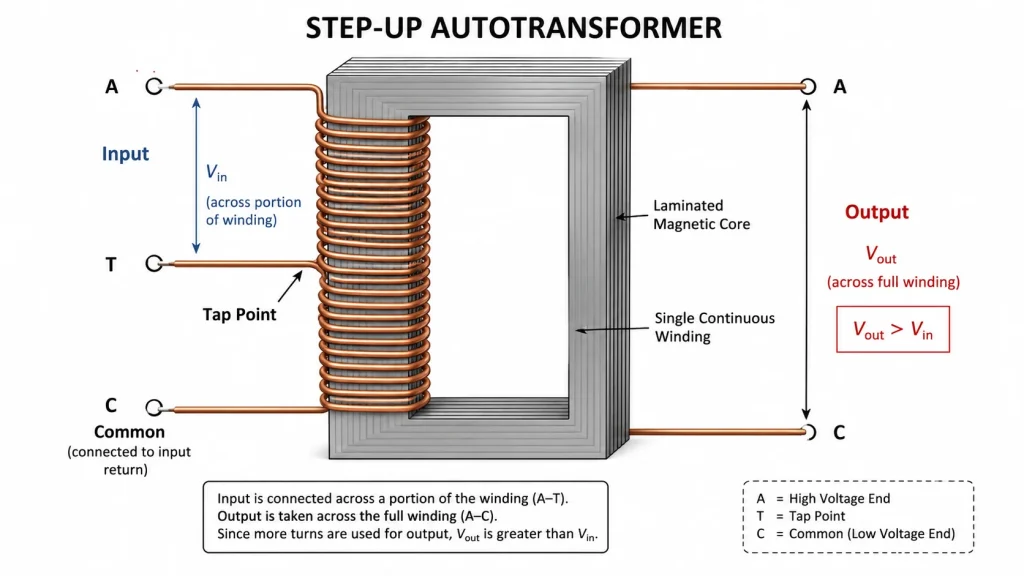
In a step-up autotransformer, the input voltage is applied across a portion of the winding, and the output is taken across the entire winding. Since the output taps span more turns than the input section, the output voltage is higher than the input voltage. The voltage ratio follows the same turn-ratio principle used in conventional transformers:
Vout / Vin = Ntotal / Ninput
For example, if an autotransformer has 200 turns total and the input is applied across 100 turns, the output voltage will be twice the input voltage. If you apply 120 V across the lower half, the full winding delivers 240 V.
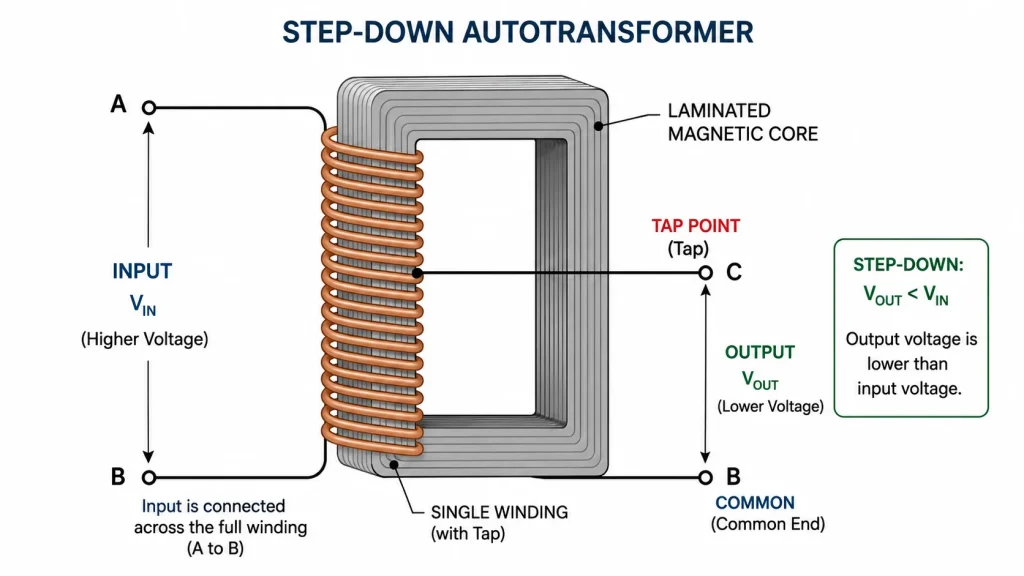
In a step-down autotransformer, the input voltage is applied across the entire winding, and the output is taken from a tap point along the winding. Since the output section has fewer turns than the input section, the voltage is reduced.
For example, if the full winding has 200 turns with 230 V applied, a tap at the 100-turn point delivers 115 V. This configuration is widely used in voltage converters, motor starters, and distribution voltage regulation.
Choosing between an autotransformer and a conventional dual-winding transformer depends on the specific application requirements. The table below highlights the key differences.
| Criterion | Autotransformer | Conventional Transformer |
|---|---|---|
| Winding arrangement | Single continuous winding | Two separate windings (primary & secondary) |
| Electrical isolation | No isolation between input and output | Galvanic isolation provided |
| Size and weight | Smaller and lighter (less copper and core material) | Larger and heavier for the same rating |
| Cost | Lower material and manufacturing cost | Higher cost |
| Efficiency | Higher (lower copper and core losses) | Lower for equivalent rating |
| Short-circuit impedance | Lower (produces higher fault currents) | Higher (limits fault current better) |
| Best voltage ratio range | Up to approximately 3:1 | Any ratio, including very high step-up or step-down |
| Safety | Less safe (no isolation; winding failure can expose output to full input voltage) | Safer (isolated circuits) |
Autotransformers are widely used to interconnect power systems operating at different voltage levels, such as linking 132 kV and 66 kV transmission networks. They also serve as voltage regulators on long distribution lines, where tap-changing autotransformers compensate for voltage drop to maintain consistent supply at the customer end. For more power solutions, browse our product catalog.
In industrial settings, autotransformers adapt machinery built for one voltage standard to operate on another—for example, running 480 V equipment on a 600 V supply. Autotransformer starters are a proven method for soft-starting large induction motors, where reduced-voltage taps (typically at 50%, 65%, and 80%) limit inrush current during acceleration.
Step up and step down autotransformers serve as travel voltage converters, allowing 230 V appliances to operate on 120 V mains and vice versa. They are also built into audio systems for impedance matching between components and into railway electrification systems to extend feeder distances on 25 kV AC networks.
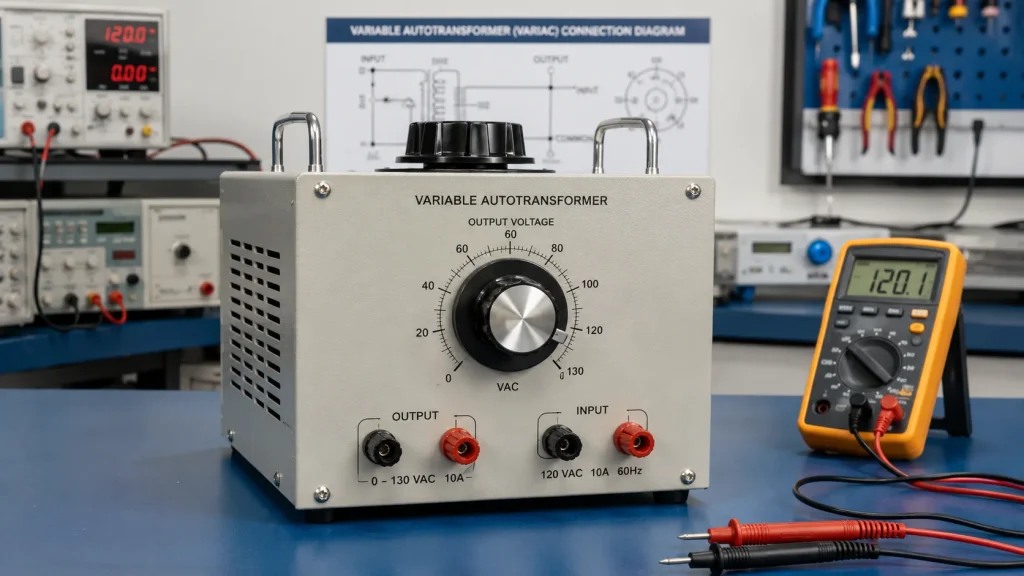
Variable autotransformers, commonly known by the trade name Variac, provide continuously adjustable AC voltage from zero to above line voltage. These are essential in repair shops, R&D labs, and production testing where equipment must be tested across its full specified voltage range.
A step up and step down autotransformer is a versatile, efficient, and cost-effective alternative to conventional dual-winding transformers for applications where electrical isolation is not required. Its single-winding design delivers higher efficiency in a smaller package, making it the preferred choice for power system interconnection, industrial motor control, voltage conversion, and laboratory testing.
When selecting between an autotransformer and a conventional transformer, the key decision factor is whether your application demands galvanic isolation. If isolation is not mandatory and the voltage ratio is within the 3:1 range, an autotransformer will almost always offer better efficiency, lower cost, and reduced footprint.
For help choosing the right autotransformer for your specific voltage requirements, contact our team to discuss your application.
This comparison is one of many technical resources we publish to support smarter component selection. Whether you’re specifying transformers for a control panel, troubleshooting voltage conversion in a retrofit project, or sourcing custom magnetics for a new product line — you’ll find detailed product guides, application notes, and datasheets to keep your project moving. Visit our home to explore our complete transformer catalog and the latest engineering content.
Yes. The same autotransformer can function as either step up or step down depending on how the input and output connections are arranged. Simply swap which terminals serve as input and which as output. However, in practice, losses mean the device is slightly more efficient in the direction it was designed for.
Most practical autotransformers operate at a voltage ratio of up to 3:1. Beyond this, the size and cost advantages over a conventional transformer decrease, and the voltage ratio no longer justifies the loss of electrical isolation.
Because the primary and secondary circuits share the same physical winding and are electrically connected. There is no separate secondary coil, so current can flow directly between input and output. A conventional transformer uses two magnetically coupled but electrically separate coils to achieve galvanic isolation.
The most common applications include power system interconnection between different voltage levels, industrial motor starters, voltage converters for international travel, audio impedance matching, laboratory variable AC supplies, and railway traction power distribution.
If the common section of the winding opens (breaks), the transformer essentially becomes an inductor in series with the load. Under light load, this can result in nearly full input voltage appearing at the output, potentially damaging connected equipment. This is why autotransformers are not recommended for applications where isolation is a safety requirement.
Yes, for the same power rating and voltage ratio, autotransformers achieve higher efficiency because they have lower copper losses (less winding material) and lower core losses (smaller core). Power autotransformers commonly reach efficiencies above 98%.