¿Qué son los autotransformadores elevadores y reductores?
Publicado: Autor: Lisa
A autotransformador elevador y reductor Es un tipo de transformador eléctrico que utiliza un único devanado continuo para aumentar (elevar) o reducir (bajar) la tensión entre sus terminales de entrada y salida. A diferencia de los transformadores convencionales de doble devanado, un autotransformador comparte parte de su devanado entre los circuitos primario y secundario, lo que lo hace más compacto, más ligero y más eficiente para aplicaciones en las que no se requiere aislamiento eléctrico.
Comprender cómo los autotransformadores elevan o reducen la tensión es fundamental para los ingenieros eléctricos, los técnicos y cualquier persona relacionada con la distribución de energía, los equipos industriales o los ensayos eléctricos. Esta guía explica el principio de funcionamiento, las diferencias clave entre las configuraciones elevadoras y reductoras, las ventajas, las aplicaciones habituales y las consideraciones de seguridad.
¿Qué es un autotransformador?
Un autotransformador es un transformador con un único devanado enrollado alrededor de un núcleo laminado. El término “auto” proviene de la palabra griega que significa “uno mismo”, lo que refleja que el devanado actúa sobre sí mismo. En este diseño, una parte del mismo devanado hace las veces tanto de bobina primaria como de bobina secundaria. El devanado tiene al menos tres terminales: dos terminales extremos y uno o más puntos de toma intermedios.
Dado que los circuitos primario y secundario comparten parte de la misma ruta conductora, la transferencia de energía se produce a través de ambos inducción electromagnética y conducción eléctrica directa. Este doble mecanismo es lo que confiere al autotransformador su ventaja en cuanto a eficiencia frente a un transformador convencional de dos devanados de características equivalentes.
Autotransformadores elevadores y reductores: cómo funcionan
La clasificación de un autotransformador como dar un paso adelante o dimitir Depende totalmente de cómo se conecten la entrada y la salida a través del devanado compartido. A menudo, un mismo dispositivo físico puede funcionar en cualquiera de los dos modos cambiando la configuración de las conexiones.
Característica
Autotransformador elevador
Autotransformador reductor
Conexión de entrada
A lo largo de un tramo de la sinuosa
A lo largo de todo el recorrido sinuoso
Conexión de salida
A lo largo de todo el recorrido sinuoso
A lo largo de un tramo de la sinuosa
Relación de tensiones
Vout > Vin
Vout < Vin
Relación de giro (N2/N1)
Mayor que 1
Menos de 1
Ejemplo habitual
Entrada de 120 V y salida de 230 V
Entrada de 230 V y salida de 120 V
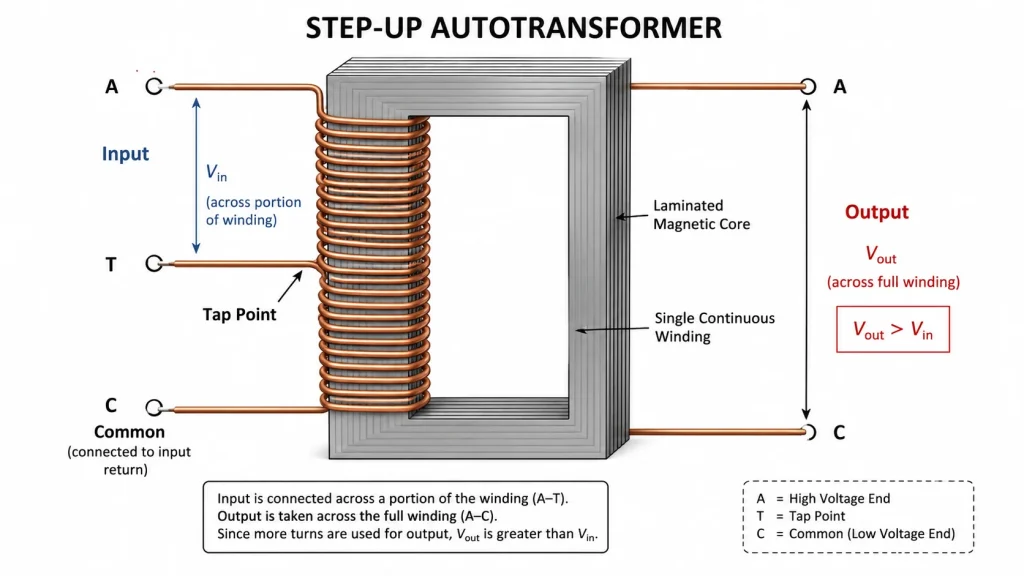
Cómo funciona un autotransformador elevador
En un autotransformador elevador, la tensión de entrada se aplica a una parte del devanado, y la tensión de salida se toma en todo el devanado. Dado que las tomas de salida abarcan más espiras que la sección de entrada, la tensión de salida es mayor que la de entrada. La relación de tensión sigue el mismo principio de relación de espiras que se utiliza en los transformadores convencionales:
Vout / Vin = Ntotal / Ninput
Por ejemplo, si un autotransformador tiene un total de 200 espiras y la tensión de entrada se aplica a 100 espiras, la tensión de salida será el doble de la tensión de entrada. Si se aplican 120 V a la mitad inferior, el devanado completo suministra 240 V.
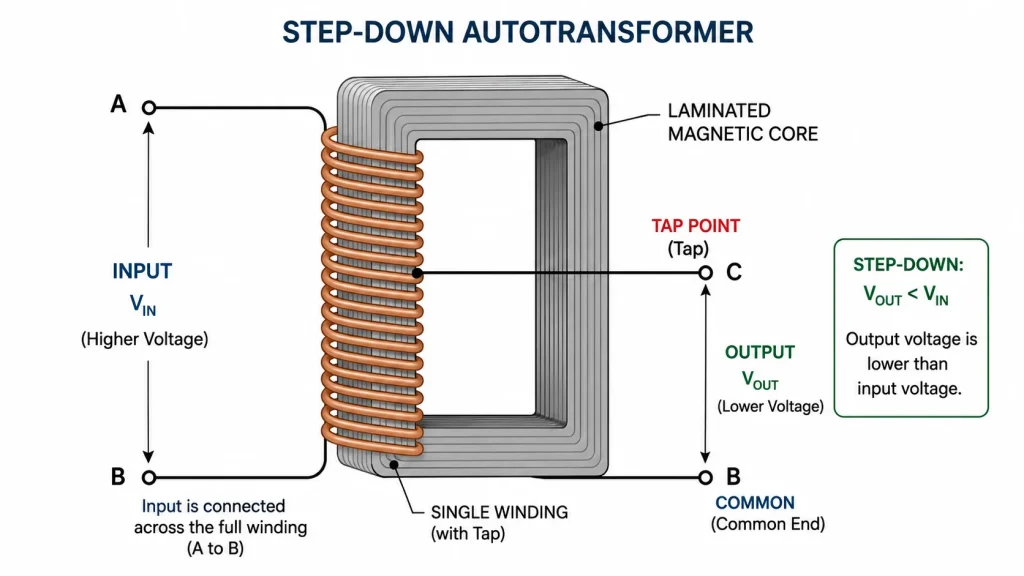
Cómo funciona un autotransformador reductor
En un autotransformador reductor, la tensión de entrada se aplica a todo el devanado, y la salida se toma de un punto de derivación situado a lo largo del devanado. Dado que la sección de salida tiene menos espiras que la de entrada, la tensión se reduce.
Por ejemplo, si el devanado completo tiene 200 espiras y se le aplica una tensión de 230 V, una toma situada en el punto de las 100 espiras suministra 115 V. Esta configuración se utiliza ampliamente en convertidores de tensión, arrancadores de motores y sistemas de regulación de tensión de distribución.
Autotransformador frente a transformador convencional
La elección entre un autotransformador y un transformador convencional de doble devanado depende de los requisitos específicos de la aplicación. En la tabla siguiente se resumen las diferencias principales.
Criterio
Autotransformador
Transformador convencional
Disposición de los bobinados
Bobinado continuo único
Dos devanados independientes (primario y secundario)
Aislamiento eléctrico
No hay aislamiento entre la entrada y la salida
Aislamiento galvánico incluido
Tamaño y peso
Más pequeño y ligero (menos cobre y material del núcleo)
Más grande y más pesado para la misma potencia nominal
Coste
Menores costes de materiales y fabricación
Mayor coste
Eficacia
Más alto (menores pérdidas por cobre y del núcleo)
Menor para una calificación equivalente
Impedancia de cortocircuito
Más baja (genera corrientes de fallo más elevadas)
Más alto (limita mejor la corriente de fallo)
Mejor rango de relación de tensión
Hasta aproximadamente 3:1
Cualquier relación, incluidas las de aumento o reducción muy elevadas
Seguridad
Menos seguro (sin aislamiento; un fallo en el devanado puede exponer la salida a la tensión total de entrada)
Más seguro (circuitos aislados)
Ventajas principales de los autotransformadores elevadores y reductores
Tamaño compacto y menor peso. Dado que solo un devanado conduce la potencia, el autotransformador requiere menos cobre y un núcleo más pequeño, lo que lo hace considerablemente más ligero y más pequeño que un transformador equivalente de dos devanados.
Mayor eficiencia. La reducción de las pérdidas en el cobre y de las pérdidas en el núcleo hace que los autotransformadores funcionen con mayor eficiencia energética, alcanzando normalmente un 98% o más en aplicaciones de potencia.
Menor coste. Un menor uso de material se traduce directamente en menores costes de fabricación, lo que resulta beneficioso para los proyectos en los que el presupuesto es una limitación.
Menor reactancia de fuga. El diseño de bobinado compartido da lugar a una menor inductancia de fuga, lo que mejora la regulación de tensión en condiciones de carga variable.
Mayor índice VA por unidad de tamaño. Con las mismas dimensiones físicas, un autotransformador puede soportar una potencia nominal en voltios-amperios mayor que un transformador convencional.
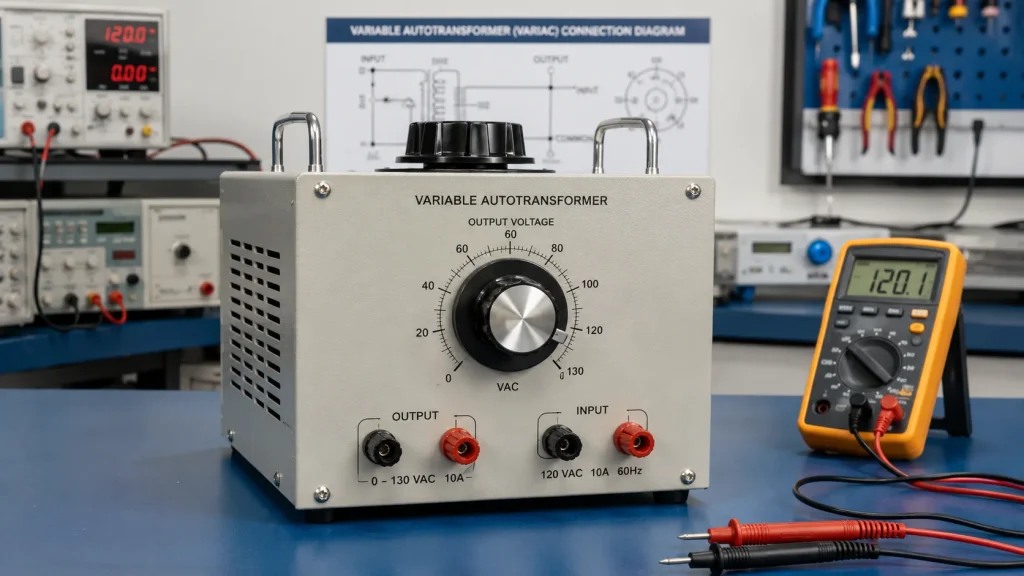
Ajuste suave de la tensión. Los autotransformadores variables con contactos deslizantes permiten ajustar la tensión de salida de forma continua, lo que resulta útil en entornos de ensayo y de laboratorio.
Aplicaciones comunes
Transmisión y distribución de energía eléctrica
Los autotransformadores se utilizan ampliamente para interconectar sistemas eléctricos que funcionan a diferentes niveles de tensión, como por ejemplo para conectar redes de transmisión de 132 kV y 66 kV. También sirven como reguladores de tensión en líneas de distribución largas, donde los autotransformadores con cambio de tomas compensan la caída de tensión para mantener un suministro constante en el punto de consumo del cliente. Para conocer más soluciones de energía, consulte nuestro catálogo de productos.
Maquinaria industrial y arranque de motores
En entornos industriales, los autotransformadores permiten adaptar la maquinaria diseñada para un estándar de tensión a otro; por ejemplo, hacer funcionar equipos de 480 V con una alimentación de 600 V. Los arrancadores con autotransformador son un método de eficacia probada para Arranque suave de motores de inducción de gran potencia, donde las tomas de tensión reducida (normalmente en 50%, 65% y 80%) limitan la corriente de arranque durante la aceleración.
Conversión de tensión para equipos
Los autotransformadores elevadores y reductores sirven como convertidores de tensión para viajes, lo que permite que los aparatos de 230 V funcionen con una red eléctrica de 120 V y viceversa. También se incorporan en sistemas de audio para la adaptación de impedancia entre componentes y en sistemas de electrificación ferroviaria para ampliar las distancias de las líneas de alimentación en redes de 25 kV CA.
Equipos de laboratorio y ensayo
Autotransformadores variables, conocidos comúnmente por el nombre comercial de Variac, proporcionan una tensión de CA ajustable de forma continua desde cero hasta un valor superior a la tensión de red. Son imprescindibles en talleres de reparación, laboratorios de I+D y pruebas de producción, donde es necesario someter a los equipos a pruebas en todo su rango de tensión especificado.
Limitaciones y consideraciones de seguridad
Sin aislamiento eléctrico. Los circuitos de entrada y salida están conectados directamente a través del devanado compartido. Cualquier fallo o sobretensión en un lado se transmite al otro, lo que supone un riesgo de descarga eléctrica y de daños en los equipos.
Riesgo de fallo del bobinado. Si se rompe la sección común del devanado, la tensión de entrada completa puede aparecer en los terminales de salida en condiciones de carga ligera. Esto supone un riesgo grave para la seguridad en aplicaciones destinadas al consumidor.
Relación de tensión limitada. Los autotransformadores resultan más económicos para relaciones de tensión de hasta aproximadamente 3:1. Más allá de este rango, las ventajas en cuanto a coste y tamaño disminuyen, y un transformador convencional se convierte en la mejor opción.
Corrientes de fallo más elevadas. La menor impedancia de fuga genera corrientes de cortocircuito más elevadas en comparación con un transformador de doble devanado, lo que exige una coordinación cuidadosa de las protecciones.
No apto para aplicaciones de corriente continua. Al igual que todos los transformadores que funcionan por inducción electromagnética, los autotransformadores no pueden aumentar ni reducir la tensión continua.
A autotransformador elevador y reductor Es una alternativa versátil, eficiente y rentable a los transformadores convencionales de doble devanado para aplicaciones en las que no se requiere aislamiento eléctrico. Su diseño de devanado único ofrece una mayor eficiencia en un tamaño más compacto, lo que lo convierte en la opción preferida para la interconexión de sistemas eléctricos, el control de motores industriales, la conversión de tensión y los ensayos de laboratorio.
A la hora de elegir entre un autotransformador y un transformador convencional, el factor clave para la decisión es si tu aplicación requiere aislamiento galvánico. Si el aislamiento no es obligatorio y la relación de tensión se encuentra dentro del rango de 3:1, un autotransformador ofrecerá casi siempre una mayor eficiencia, un menor coste y un tamaño más reducido.
Si necesitas ayuda para elegir el autotransformador adecuado para tus necesidades específicas de tensión, ponte en contacto con nuestro equipo para hablar sobre tu solicitud.
Esta comparación es uno de los muchos recursos técnicos que publicamos para facilitar una selección más acertada de los componentes. Tanto si estás seleccionando transformadores para un cuadro de control, resolviendo problemas de conversión de tensión en un proyecto de modernización o buscando componentes magnéticos a medida para una nueva línea de productos, encontrarás guías detalladas de productos, notas de aplicación y fichas técnicas que te ayudarán a sacar adelante tu proyecto. Visita nuestra Inicio para consultar nuestro catálogo completo de transformadores y los últimos contenidos técnicos.
PREGUNTAS FRECUENTES
¿Se puede utilizar un autotransformador tanto para elevar como para reducir la tensión?
Sí. Un mismo autotransformador puede funcionar tanto como elevador como reductor, dependiendo de cómo se dispongan las conexiones de entrada y salida. Basta con intercambiar los terminales que sirven de entrada y los que sirven de salida. Sin embargo, en la práctica, debido a las pérdidas, el dispositivo es ligeramente más eficiente en la dirección para la que fue diseñado.
¿Cuál es la relación de elevación máxima de un autotransformador?
La mayoría de los autotransformadores que se utilizan en la práctica funcionan con una relación de tensión de hasta 3:1. Más allá de este valor, las ventajas en cuanto a tamaño y coste con respecto a un transformador convencional disminuyen, y la relación de tensión ya no justifica la pérdida de aislamiento eléctrico.
¿Por qué un autotransformador no proporciona aislamiento eléctrico?
Esto se debe a que los circuitos primario y secundario comparten el mismo devanado físico y están conectados eléctricamente. No hay una bobina secundaria independiente, por lo que la corriente puede circular directamente entre la entrada y la salida. Un transformador convencional utiliza dos bobinas acopladas magnéticamente, pero separadas eléctricamente, para lograr el aislamiento galvánico.
¿Dónde se utilizan con mayor frecuencia los autotransformadores elevadores y reductores?
Entre sus aplicaciones más habituales se encuentran la interconexión de redes eléctricas entre distintos niveles de tensión, los arrancadores de motores industriales, los convertidores de tensión para viajes internacionales, la adaptación de impedancia de audio, las fuentes de alimentación de CA variables para laboratorios y la distribución de energía de tracción ferroviaria.
¿Qué ocurre si falla un devanado del autotransformador?
Si se abre (se rompe) la sección común del devanado, el transformador se convierte, en esencia, en un inductor en serie con la carga. Con una carga ligera, esto puede provocar que en la salida aparezca una tensión de entrada casi completa, lo que podría dañar los equipos conectados. Por este motivo, no se recomienda el uso de autotransformadores en aplicaciones en las que el aislamiento sea un requisito de seguridad.
¿Son los autotransformadores más eficientes que los transformadores convencionales?
Sí, para una misma potencia nominal y una misma relación de tensión, los autotransformadores alcanzan una mayor eficiencia porque presentan menores pérdidas en el cobre (menos material de bobinado) y menores pérdidas en el núcleo (núcleo más pequeño). Los autotransformadores de potencia suelen alcanzar eficiencias superiores a 98%.
Transformador de 230 V a 110 V para España: conformidad con la norma REBT, ITC-BT-18 e ITC-BT-24, puesta a tierra del secundario y documentación conforme a la norma UNE-EN IEC 61558.
Transformador de 230 V a 110 V para los Países Bajos: norma NEN 1010, normas sobre dispositivos de protección contra fugas a tierra de 30 mA, diferencia entre «aardlekschakelaar» y «aardlekautomaat», y puesta a tierra secundaria.
Transformador de 230 V a 110 V para Francia: NF C 15-100, puesta a tierra TT, protección diferencial de 30 mA y cuándo conectar a tierra el secundario.