Autotransformator-Typen: Aufwärtstransformator, Abwärtstransformator, Variac, 3-Phasen-Transformator und mehr
Veröffentlicht: Autor: Lisa
Spartransformatoren are not a one-size-fits-all device. They come in distinct types, each built for a specific range of voltage ratios, phase configurations, control methods, and application environments. Choosing the right autotransformer type means matching these design characteristics to your load, your supply, and your operating conditions. This guide classifies every major autotransformer type so you can quickly identify which one fits your project.
How Autotransformer Types Are Classified
All autotransformers share the same basic principle — a single winding with shared primary and secondary sections — but their practical designs differ across five classification dimensions:
Understanding these dimensions lets you narrow down the options quickly. The sections below walk through each classification in detail. If you are new to autotransformers altogether, start with our introduction to what an autotransformer is.
Types of Autotransformers by Voltage Function
The most fundamental classification is what the transformer does to the voltage: raise it, lower it, or do both.
Step-Up Autotransformers
A Aufwärtstransformator increases voltage from input to output. The input is connected across a portion of the winding (the lower-voltage section), and the output is taken across the full winding. Because output turns exceed input turns, the voltage rises proportionally.
Common step-up configurations include 110V to 220V for running North American equipment on European/Asian mains, or 240V to 480V for industrial machinery. The turns ratio directly sets the voltage gain: connecting input at a 50% tap on a 220V winding delivers 440V at the full-winding output terminals.
Step-Down Autotransformers
A Abwärtstransformator reduces voltage. The full winding receives the higher input voltage, and the load connects to a tap point lower on the winding. This is the most common configuration in consumer voltage converters that step 220V-240V down to 110V-120V for imported appliances.
In step-down mode, the current in the common winding section equals the difference between input and output current, which means less copper loss and cooler operation. This is one reason step-down autotransformers run efficiently even under continuous load.
Buck-Boost Autotransformers
A buck-boost autotransformer is a specialized type designed to make small voltage corrections — typically 5% to 20% — rather than full-range conversion. It bucks (reduces) or boosts (increases) voltage by a small increment. These are common in distribution systems where line voltage drifts slightly out of tolerance and needs a minor correction without a full transformer replacement.
Voltage Function
Eingangsanschluss
Output Connection
Typical Ratio
Gemeinsame Nutzung
Step-Up
Across a portion of winding
Across full winding
1:2 to 1:3
110V to 220V equipment
Step-Down
Across full winding
Across a portion of winding
2:1 to 3:1
220V to 110V appliances
Buck-Boost
Across full winding
Across winding + series addition/subtraction
0.8:1 to 1.2:1
Line voltage correction
Types of Autotransformers by Control Method
How the output voltage is set — fixed, manually adjustable, or automatically regulated — determines the control type. This classification has the biggest impact on your day-to-day user experience.
Autotransformatoren mit festem Übersetzungsverhältnis
A Autotransformator mit festem Übersetzungsverhältnis has permanently set tap points that deliver a specific output voltage for a known input. Once wired, the output voltage does not change unless you physically reconnect the terminals to a different tap. These units have no moving parts, require no maintenance, and are the simplest, most rugged type.
Fixed-ratio autotransformers are the standard choice for step-up and step-down voltage conversion in equipment that always runs at the same voltage. The DT/ST Series autotransformers from Johsun Tec are fixed-ratio designs covering 100VA to 10kVA with multiple input/output voltage combinations.
Variable Autotransformatoren (Variac)
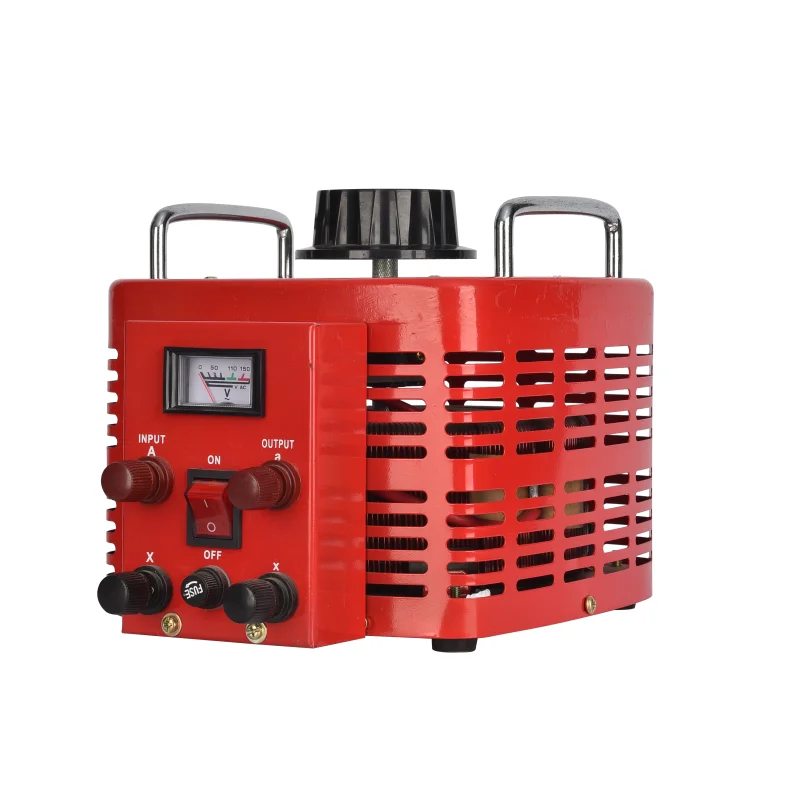
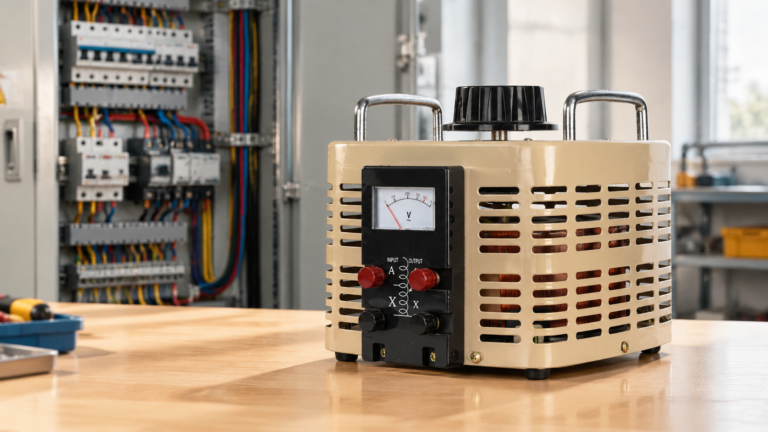
A Autotransformator mit variabler Spannung, widely known by the trade name Variac, replaces fixed taps with a rotating carbon brush that slides along an exposed winding track. Turning the knob moves the brush across the winding, delivering a continuously adjustable output voltage from zero to approximately 117% of the input voltage.
Variable autotransformers are indispensable in laboratories, repair shops, test benches, and production lines where equipment must be tested under different input voltages. They produce a clean sine-wave output without the waveform distortion introduced by electronic dimmers or thyristor controllers. For more details, browse our variable transformer product category.
It is important to note that a variable autotransformer does not provide isolation. The output is electrically connected to the mains input through the winding. For test bench setups that require isolation, an isolation transformer must be placed upstream of the variac.
Tap-Changing Autotransformers (Automatic Voltage Regulators)
A tap-changing autotransformer adjusts its output voltage automatically using motor-driven or relay-switched tap selectors. A voltage sensing circuit monitors the output and commands the tap changer to move up or down to maintain a stable output despite fluctuations in the input voltage or load.
These units are common in power distribution networks where long rural feeders experience voltage drop, and in industrial plants where sensitive machinery needs tightly regulated supply voltage. Automatic tap changers can operate under load (on-load tap changers, OLTC) or require a brief de-energization (off-load tap changers).
Control Type
Adjustment
Moving Parts
Am besten geeignet für
Fixed-Ratio
None — set at installation
Keine
Permanent voltage conversion installations
Variable (Variac)
Manual, continuous
Rotating brush on winding
Lab testing, R&D, repair benches
Tap-Changing (Automatic)
Automatic, stepped
Motorized or relay tap selector
Distribution regulation, sensitive industrial loads
Autotransformer Types by Number of Phases
The number of phases an autotransformer handles is one of the first questions to answer when selecting a unit. Single-phase and three-phase autotransformers have fundamentally different internal structures and terminal layouts.
Single-Phase Autotransformers
A single-phase autotransformer has one continuous winding on a single magnetic core. It works with standard residential and light commercial single-phase AC supplies. These are the most common autotransformer type in consumer voltage converters, small test equipment, and appliance-level voltage matching.
Single-phase units are available in both step-up and step-down configurations, as fixed-ratio or variable models. They are rated from a few VA for small electronic loads to several kVA for whole-machine conversion.
Dreiphasen-Autotransformatoren
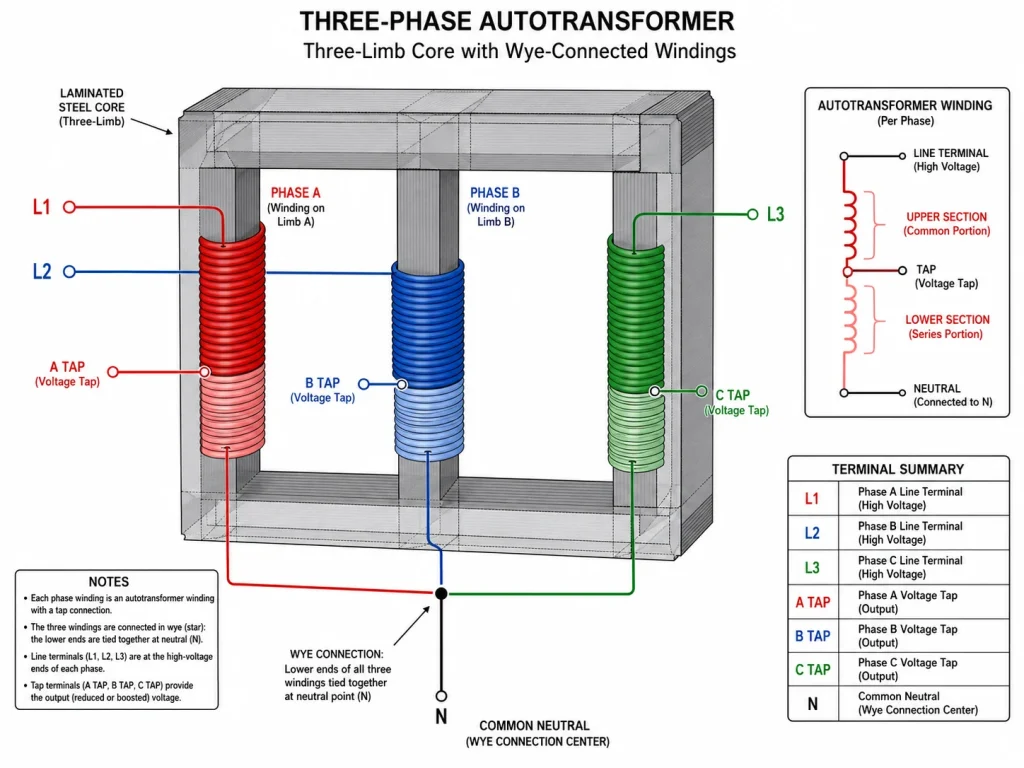
A three-phase autotransformer handles all three phases of an industrial AC supply. It can be constructed in two ways: three separate single-phase autotransformer units connected together, or a single three-limb magnetic core with windings for all three phases.
Three-phase auto transformer units are widely used in motor starting, industrial voltage conversion, and power transmission interconnection. They are available in two primary winding connection configurations:
Wye (Star) connection: The three windings share a common neutral point. Each phase winding has its own tap points. A wye-connected three-phase autotransformer can supply both line-to-line and line-to-neutral voltages, making it the preferred choice when a neutral is required.
Delta connection: The three windings form a closed loop with no neutral point. Delta-connected units are more common in motor-starting applications and systems where loads are balanced across all three phases.
A specialized variant called a zigzag autotransformer provides a neutral-derived grounding reference on systems that otherwise have no neutral connection. These are used in distribution networks and are valued for their ability to handle zero-sequence currents.
Konfiguration
Neutral Available
Typische Anwendung
Phase Balance Required
Einphasig
N/A
Residential, light commercial, small equipment
No
Three-Phase Wye
Ja
Distribution, industrial voltage conversion with neutral loads
A 3-phase variac — also called a three-phase variable transformer oder 3 phase variable transformer — is simply three variable autotransformer sections ganged together on a common shaft. Turning a single knob adjusts the output voltage on all three phases simultaneously and proportionally.
These units are used in three-phase motor testing, industrial process control, and laboratory environments that need adjustable three-phase AC supply. They maintain phase balance automatically if the input phases are balanced. Output voltage on each phase can typically be adjusted from zero to line voltage or slightly above.
When selecting a three phase variable transformer, confirm that:
The per-phase current rating meets your maximum single-phase load, not just the three-phase average
The input voltage matches your supply (208V, 380V, 400V, 415V, or 480V three-phase)
The unit is rated for continuous operation at the highest output voltage setting you plan to use
Types of Autotransformers by Core and Winding Design
The physical construction of the magnetic core and winding significantly impacts size, weight, efficiency, and noise.
Toroidal Autotransformers
A toroidal autotransformer uses a donut-shaped magnetic core with the winding distributed evenly around its circumference. This design offers the highest power density for the lowest weight. Toroidal autotransformers have very low stray magnetic fields, which makes them ideal for audio equipment and sensitive instrumentation where electromagnetic interference must be minimized.
The toroidal design is common in the STU series voltage converters — compact, lightweight units that efficiently convert between 110V and 220V with low radiated noise. Toroidal cores also produce less mechanical hum than laminated EI-core designs, a benefit for residential and office installations.
EI Laminated-Core Autotransformers
Eine EI-core autotransformer uses stacked E-shaped and I-shaped silicon steel laminations. This is the traditional transformer core shape and remains dominant for larger power ratings where toroidal winding becomes mechanically impractical. EI-core units are easier to manufacture in high kVA ratings, provide good heat dissipation, and accept multiple tap points readily.
The DT series step-up and step-down autotransformers use EI laminated cores, which support the rugged construction needed for industrial environments and continuous-duty operation up to 10kVA.
Core Type
Effizienz
EMI/Noise
Weight
Best Power Range
Toroidal
Highest
Sehr niedrig
Lightest
Up to 5kVA
EI Laminated
Hoch
Mäßig
Heavier
100VA to 10kVA and above
Types of Autotransformers by Application
Some autotransformer types are purpose-built for a specific job. Understanding application-specific designs helps you avoid using the wrong type for your needs.
Motor-Starting Autotransformers
Motor-starting autotransformers provide reduced-voltage starting for large induction motors. They have taps at 50%, 65%, and 80% of the line voltage. During startup, the motor receives reduced voltage to limit inrush current. Once the motor reaches near-rated speed, a contactor bypasses the autotransformer completely and connects the motor directly to the line. This is the Korndorfer starting method.
Motor-starting autotransformers are duty-cycle-rated (not continuous), which means they can only handle the starting period before needing to cool down. Using a motor-starting autotransformer for continuous voltage conversion will cause overheating and failure.
Distribution Autotransformers
These are large three-phase units used in utility power systems to interconnect transmission networks running at different voltages. A typical example is a 220kV/132kV autotransformer that links a higher-voltage transmission line to a lower-voltage sub-transmission network. Distribution autotransformers often include on-load tap changers (OLTC) for automatic voltage regulation.
Laboratory and Test Autotransformers
Laboratory autotransformers are almost always the variable (Variac) type. They provide an adjustable AC supply for testing equipment performance across a range of input voltages, calibrating instruments, and simulating abnormal line conditions. Their clean sinusoidal output makes them preferable to electronic AC sources for many precision measurements.
Audio Impedance-Matching Autotransformers
In audio systems, small tapped autotransformers match impedance between amplifier outputs and speaker loads. A single autotransformer can convert between balanced and unbalanced lines and adapt different impedance standards. These are low-power units designed for signal-level rather than power-level applications.
How to Select the Right Autotransformer Types
Narrowing down the autotransformer types to the one that fits your project becomes straightforward when you answer these questions in order:
Single-phase or three-phase? Match your supply and load configuration. Three-phase loads require a three-phase autotransformer.
Step-up or step-down? Check whether your output voltage is higher or lower than your input. For small corrections under 20%, a buck-boost type may be sufficient.
Fixed or variable output? If your load always runs at one voltage, a fixed-ratio unit is simpler, cheaper, and more reliable. If you need adjustable output, choose a variable autotransformer.
What kVA rating? Calculate total load kVA and add a 20-25% safety margin. Oversizing slightly costs little but ensures long service life.
Where will it be installed? Indoor environments allow open-frame or ventilated enclosures. Outdoor or dusty environments need sealed enclosures rated NEMA 3R or IP54.
Autotransformers are classified primarily by voltage function (step-up, step-down, buck-boost), control method (fixed-ratio, variable/Variac, tap-changing), and number of phases (single-phase, three-phase wye, three-phase delta). Most practical units combine these dimensions — for example, a fixed-ratio single-phase step-down autotransformer for 220V-to-110V conversion.
What is a 3 phase auto transformer?
A 3-Phasen-Autotransformator is an autotransformer designed for three-phase AC systems. It uses three windings — either on a shared three-limb core or as three separate single-phase units — connected in wye or delta configuration. These are used in industrial motor starting, voltage conversion for three-phase equipment, and power distribution interconnection between transmission networks.
What is the difference between a variac and a fixed autotransformer?
A variac (variable autotransformer) provides continuously adjustable output voltage via a rotating brush that slides along the winding. A fixed autotransformer has preset tap points and delivers one specific output voltage for a given input. Variacs are ideal for testing and adjustable applications; fixed units are better for permanent installations where voltage requirements are stable.
Can I use a three-phase variac for single-phase loads?
Yes, but only on one phase at a time. A three-phase variable transformer with wye output can supply single-phase loads between any phase and neutral, provided the per-phase current rating is not exceeded. However, drawing unbalanced single-phase loads from a three-phase variac can cause uneven brush wear over time.
What type of autotransformer is used for motor starting?
Motor-starting autotransformers are fixed-ratio units with taps at 50%, 65%, and 80% of line voltage. They are duty-cycle-rated (not continuous) and are connected only during the motor start-up period before being bypassed by a contactor. The Vergleich zwischen Autotransformator und Regeltransformator explains when each type is appropriate.
Which autotransformer type is most efficient?
Toroidal-core autotransformers consistently achieve the highest efficiency — often above 98% — because their uniform winding distribution minimizes leakage flux and copper loss. Among fixed-ratio and variable types, fixed-ratio units are more efficient than variable units at the same power rating because they have no brush contact resistance losses.
What is the practical kVA range for different autotransformer types?
Single-phase fixed-ratio units range from 50VA to 15kVA. Variable autotransformers typically go up to 5kVA per phase for single-phase, or 15kVA total for three-phase ganged units. Distribution-grade three-phase autotransformers for utility applications scale into the hundreds of MVA.
Autotransformer Types at a Glance
Typ
Spannung
Phase
Adjustment
Am besten geeignet für
Fixed-Ratio Step-Down
Output < Input
1-Phase
Keine
Equipment voltage conversion
Fixed-Ratio Step-Up
Output > Input
1-Phase
Keine
Running equipment on higher-voltage mains
Buck-Boost
Small correction
1-Phase
Keine
Line voltage trimming
Variable (Variac)
0-117% of input
1-Phase
Continuous manual
Lab testing, repair, dimming
3-Phase Variac
0-line voltage
3-Phase
Continuous ganged
Industrial motor testing, 3-phase R&D
Tap-Changing
Regulated
1- or 3-Phase
Automatic stepped
Distribution voltage regulation
Motor-Starting
50/65/80% taps
3-Phase
Fixed taps
Induction motor soft start
Toroidal
Beliebiges Verhältnis
1-Phase
Fixed or variable
Audio, compact converters, low-noise zones
If you need a specific autotransformer type and are unsure which model fits your voltage, phase, and kVA requirements, browse the full transformer product range oder get in touch with our team for a recommendation based on your load specifications.
How a buck-boost transformer works: series-winding polarity, differential kVA sizing with single-phase and three-phase examples, and the five limits that decide when it is the wrong tool.
How to size a step-up transformer for a motor: locked-rotor current, kVA code letters, starting kVA by method, voltage-dip and thermal-duty checks, plus the traps most guides miss.
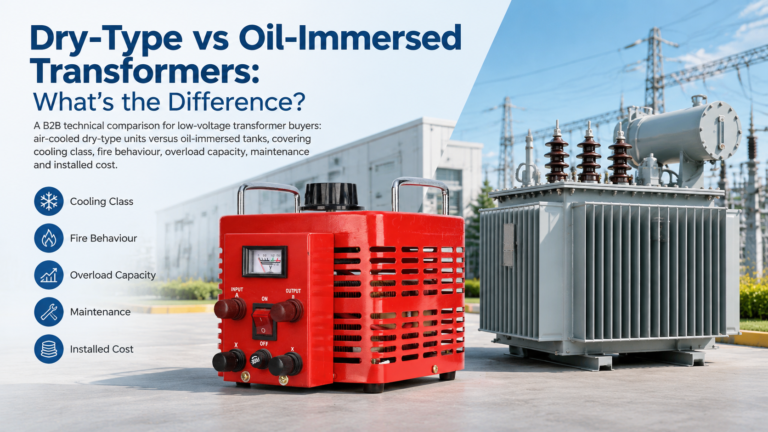
A practical dry-type vs oil-immersed transformer comparison for low-voltage buyers: cooling class, fire safety, overload, maintenance and installed cost, plus a ten-minute selection sequence.