Step Up and Step Down Transformer Supplier Johsun Tec
Published: Author: Lisa
A Johsun Tec step up and step down transformer Supplier is mainly used when the equipment voltage does not match the local power supply. For B2B buyers, this is not a small detail. A wrong voltage converter can cause overheating, poor equipment operation, nuisance fuse trips, or a failed bulk purchase when products arrive in the target market.
The problem usually looks simple: a device needs 110V but the site provides 220V, or a machine needs 220V but the customer market uses 110V. The buying decision, however, should not stop at voltage direction. You also need to check capacity, load type, frequency, socket design, protection method, export requirements, and whether the supplier can support wholesale, OEM, ODM, private label, or customized orders.
This guide explains how to evaluate a step up & down transformer from a practical procurement perspective, especially for distributors, importers, electrical companies, equipment manufacturers, and buyers sourcing from a China transformer supplier.
What Is Step Up and Step Down Transformer?
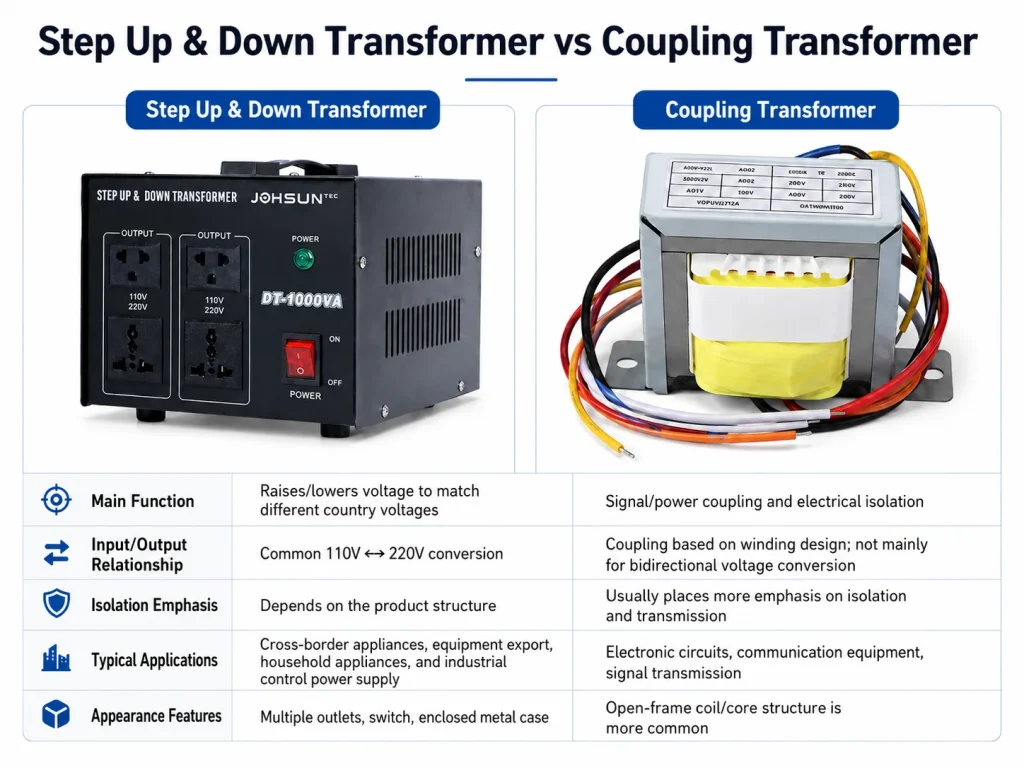
A step up transformer increases voltage from a lower level to a higher level. A step down transformer reduces voltage from a higher level to a lower level. A Best Voltage Converter 110 to 220V step up and step down transformer is designed for two-way voltage conversion, such as 110V to 220V or 220V to 110V, depending on the model design and input selector.
For example, if a distributor sells imported appliances in a 220V market, customers may need a voltage converter from 220V to 110V. If a factory uses 110V supply but needs to test 220V equipment, the required direction is reversed.
Transformer type
Voltage direction
Typical use case
Key selection concern
Step up transformer
Lower to higher
110V supply to 220V equipment
Output voltage and load capacity
Step down transformer
Higher to lower
220V supply to 110V equipment
Continuous load and heat control
Step up & down transformer
Two-way conversion
Distributors serving multiple markets
Input selector, socket, protection, and rating
For readers searching “difference between step up and step down transformer class 10,” the basic distinction is voltage direction. For global buyers, working with a reliable Step Up and Step Down Transformer Supplier ensures stable specification control and consistent bulk procurement quality.
You need a step up & down transformer when the equipment voltage and the local grid voltage are different, and the equipment cannot directly accept the available supply.
Common B2B scenarios include:
A wholesaler imports 110V equipment for customers in 220V or 240V markets.
An exporter ships 220V equipment to a country where many users need 110V or 120V.
A maintenance team tests devices from different voltage regions.
A distributor wants one voltage converter series that can cover multiple customer markets.
A factory needs voltage conversion for samples, test equipment, small machines, printers, fans, or office devices.
Scenario
Example buyer
Conversion needed
What to confirm
Selling 110V products in 220V countries
Distributor or importer
220V to 110V
Plug type, capacity, user market
Testing 220V samples in a 110V facility
Factory or lab
110V to 220V
Continuous load and frequency
Supplying mixed-voltage markets
Exporter or wholesaler
Both directions
Input selector and model range
Supporting field service
Equipment service company
Depends on job site
Portability and protection
Johsun Tec lists step up and step down transformer products as a dedicated transformer category, which makes it easier for buyers to compare voltage converter options after defining the application and capacity range.
Step Up vs Step Down vs Auto Transformer: How to Choose
“Step up” and “step down” describe the voltage direction. “Auto transformer” describes a transformer design. This distinction matters because some buyers search for “auto transformer step up and step down” but may actually need to confirm whether isolation, compact size, or cost is more important.
An auto transformer can be suitable when the buyer needs efficient voltage conversion in a compact format and electrical isolation is not the primary requirement. However, it should not be chosen only because the price looks attractive. The supplier should confirm whether the design matches the connected load, target country, and safety expectations.
Option
Best fit
Main limitation
Selection logic
Step up transformer
Higher output voltage required
One direction only unless designed otherwise
Use when supply voltage is lower than equipment voltage
Step down transformer
Lower output voltage required
One direction only unless designed otherwise
Use when supply voltage is higher than equipment voltage
Step up & down transformer
Flexible market use
Must check selector and socket design
Use for distributors, mixed inventory, and export support
Auto transformer
Compact voltage conversion
May not provide isolation
Use only after confirming safety and application needs
For B2B procurement, the supplier should explain whether a model is intended for domestic appliances, commercial equipment, test instruments, or industrial loads. This is more useful than comparing only the transformer name.
Key Step Up and Step Down Transformer Specifications to Check
Transformer specifications determine whether the product will work safely in the real application. For buyers comparing step up and step down transformer specifications, the most important items are capacity, input voltage, output voltage, frequency, load type, and protection.
Specification
Why it matters
Common mistake
What to ask the supplier
VA / W / kVA rating
Defines load capacity
Matching 1000VA to a 1000W motor without margin
What margin is recommended for this load type?
Input voltage
Must match local supply
Buying 220V input for a 110V market
Is the input selector suitable for my country?
Output voltage
Must match equipment
Assuming 110V and 120V are always the same
What output range is available?
Frequency
Affects some motors and timing devices
Ignoring 50Hz vs 60Hz
Is the equipment compatible with local frequency?
Protection
Reduces risk during abnormal use
Choosing by price only
Fuse, MCB, thermal protection, or other options?
Socket and plug
Affects market usability
Not checking target country plug type
Can socket or plug be customized?
Johsun Tec DT/ST Series page states that the series covers 100VA–10KVA and supports 110V–220V conversion, with features such as input voltage selection, socket options, carrying handle, ON/OFF switch, and fuse/MCB protection.
How to Select the Right Capacity for 110V to 220V or 220V to 110V
The right voltage converter is not always the model closest to the equipment wattage. Many devices draw more current at startup than during normal operation. Motors, compressors, pumps, heating devices, and some office equipment may need extra capacity.
A safer buying process is:
Check the equipment nameplate voltage and wattage.
Identify whether the load is resistive, electronic, motor-driven, or inductive.
Add a safety margin based on startup current and working time.
Confirm whether the transformer will run continuously or occasionally.
Ask the supplier to verify the model before bulk purchase.
Capacity range
Typical load example
Buyer type
Selection caution
100VA–300VA
Small electronics, test devices
Retail distributor, lab buyer
Avoid motor loads unless confirmed
500VA–1500VA
Printers, small appliances, office devices
Wholesaler, service company
Check startup current
2000VA–3000VA
Larger appliances, field equipment
Importer, equipment supplier
Confirm heat and continuous use
5000VA and above
Higher-load commercial use
Factory, project buyer
Confirm wiring, protection, and installation
For compact procurement ranges, Johsun Tec’s STU Series 100VA–3000VA may be reviewed by buyers comparing smaller and medium-capacity voltage converter options. The company’s page describes this range as STU Series 100VA–3000VA for industrial, commercial, and distribution buyers.
For distributors focused on lower-capacity travel or portable voltage conversion, the DT/ST Series 100VA–1500VA can be compared against target market demand. Johsun Tec describes this range as 100VA–1500VA and notes use across voltage regions for mobile, field, and temporary applications.
For higher capacity comparison, the STU Series 100VA–5000VA can help buyers evaluate whether the procurement plan needs a broader model range. Johsun Tec’s page presents this series as 100VA–5000VA, although buyers should confirm whether the required output is AC voltage conversion or DC output before ordering.
What B2B Buyers Should Check When Choosing a China Transformer Supplier
Finding a Step Up and Step Down Transformer Supplier in China is not only about searching for the lowest wholesale price. For importers, distributors, and electrical product companies, the supplier’s manufacturing capability, documentation, customization process, and export support can affect the entire procurement cycle.
Evaluation item
Why it matters
Questions to ask
Manufacturer or trading company
Impacts customization and technical feedback
Are you the factory or sourcing from another maker?
Model range
Affects distributor inventory planning
Which VA/kVA ratings are stable for bulk purchase?
OEM / ODM support
Needed for private label and white label projects
Can logo, packaging, socket, plug, and manual be customized?
Export experience
Reduces shipping and documentation issues
Which markets do you commonly support?
Quote clarity
Prevents hidden cost confusion
Does the price include packaging, plug, MOQ, and lead time?
Technical confirmation
Reduces after-sales problems
Can your engineer confirm model selection before order?
Johsun Tec states that it provides voltage regulators, transformers, UPS systems, inverters, and solar solutions, and highlights OEM/ODM services and global export support on its official website.
For a B2B buyer, this matters because a step up down transformer 220V to 110V is often part of a larger procurement plan. A distributor may need carton design, private label support, stable repeat orders, and price tiers for wholesale or bulk purchase. An equipment manufacturer may need a customized voltage converter matched to a specific market.
Johsun Tec Transformer Options for Different Procurement Needs
Johsun Tec offers several product ranges that can be reviewed according to capacity, voltage conversion direction, and buyer profile. The goal is not to choose the most powerful model by default. The better approach is to match the transformer to the load and the procurement channel.
Procurement need
Suitable reference
Why it may fit
Broad 110V/220V conversion range
DT/ST Series 100VA–10KVA
Useful for buyers comparing multiple capacity levels
Compact or distributor-ready models
STU 100VA–3000VA
Suitable for smaller and mid-range converter sourcing
Lower-capacity field or travel use
DT/ST 100VA–1500VA
Helps wholesalers target portable voltage conversion needs
Higher-capacity comparison
STU 100VA–5000VA
Relevant when 3000VA is not enough
Voltage stability concern
SVC-TND 3KVA–10KVA
Consider when the issue is unstable voltage, not only voltage mismatch
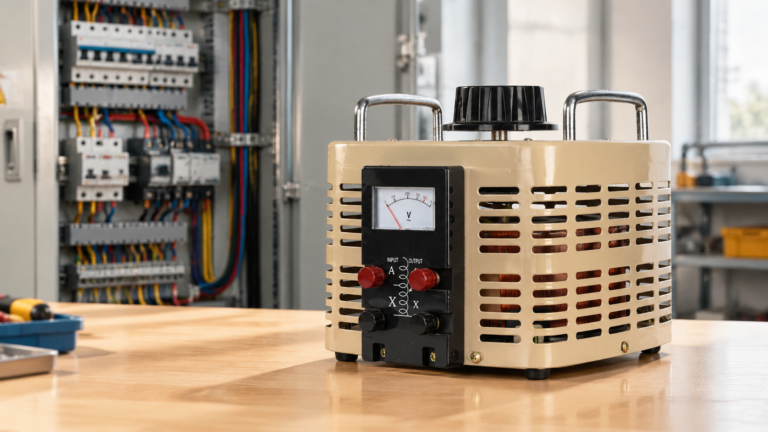
Some buyers confuse voltage conversion with voltage stabilization. A step up & down transformer changes voltage level. A stabilizer is used when the supply voltage fluctuates and needs regulation. For projects where voltage fluctuation is also a concern, Johsun Tec’s SVC-TND Series 3KVA–10KVA voltage stabilizer can be reviewed as a related power management option, not as a direct replacement for a step up and step down transformer. Johsun Tec identifies this product as a single-phase servo motor automatic voltage stabilizer in the 3KVA–10KVA range.
Common Mistakes When Buying Step Up and Step Down Transformers
Choosing by price before checking the load
A low price can become expensive if the transformer is undersized. For wholesale buyers, a wrong model can create return claims, damaged reputation, and inventory that does not match the market.
Ignoring startup current
Some equipment pulls much higher current during startup than during normal running. If the transformer is selected only by rated running wattage, it may trip protection or overheat.
Confusing watts, VA, and kVA
VA and watts are related but not always identical in practical selection. Power factor, load type, and startup behavior affect how much transformer capacity is needed.
Not confirming frequency
A Best Voltage Converter 110 to 220V still needs frequency compatibility. A transformer can change voltage, but it does not automatically convert 50Hz to 60Hz. This can matter for motors, clocks, timers, and some appliances.
Comparing brands without comparing specifications
Searches such as “power bright step up and down transformer” show that buyers often compare brands. The useful comparison should focus on voltage range, capacity, protection, plug type, certification needs, order quantity, and supplier support rather than brand name alone.
How to Choose the Right Johsun Tec Step Up and Step Down Transformer
Choosing a Johsun Tec Manufacturer step up and step down transformer should start with the voltage problem: 110V to 220V, 220V to 110V, or both. After that, the real buying decision depends on VA/kVA capacity, continuous load, startup current, frequency, plug design, protection, and target market requirements.
For B2B procurement, Step Up and Step Down Transformer Supplier evaluation is just as important as model selection. A manufacturer, factory, exporter, wholesaler, or distributor partner should be able to support technical confirmation, bulk purchase planning, OEM, ODM, private label, white label, customized packaging, and clear pricing.
Before placing a bulk order, share your input voltage, output voltage, equipment load, load type, target country, quantity, and customization needs with Johsun Tec’s team. That gives the supplier enough information to recommend a suitable transformer range instead of simply quoting the nearest model by price.
What is the difference between a step up and step down transformer?
A step up transformer increases voltage, while a step down transformer reduces voltage. In practical buying terms, the direction depends on whether your equipment voltage is higher or lower than the local power supply.
Can one transformer convert both 110V to 220V and 220V to 110V?
Yes, some step up u0026amp; down transformer models are designed for two-way conversion. Buyers should confirm the input selector, output voltage, socket type, and capacity before using one model for both directions.
How do I choose the right VA capacity for a step up u0026amp; down transformer?
Start with the equipment wattage, then add a safety margin based on the load type. Motors, compressors, pumps, and heating equipment often require more capacity than simple electronic devices.
Is an auto transformer suitable for step up and step down voltage conversion?
An auto transformer can be suitable for some voltage conversion needs where compact size and cost matter. However, buyers should confirm whether isolation is required and whether the design fits the target application.
What should distributors check before bulk purchasing from China?
Distributors should check model range, MOQ, wholesale price, packaging, socket standard, OEM/ODM support, lead time, and export documentation. They should also ask the supplier to confirm capacity selection based on real equipment loads.
Is a 1000VA or 3000VA transformer enough for my equipment?
It depends on the equipment wattage, startup current, and operating time. A 1000VA transformer may be enough for some moderate loads, while a DT-3000VA level model may be needed for higher loads, but the supplier should verify the application before order confirmation.
How a buck-boost transformer works: series-winding polarity, differential kVA sizing with single-phase and three-phase examples, and the five limits that decide when it is the wrong tool.
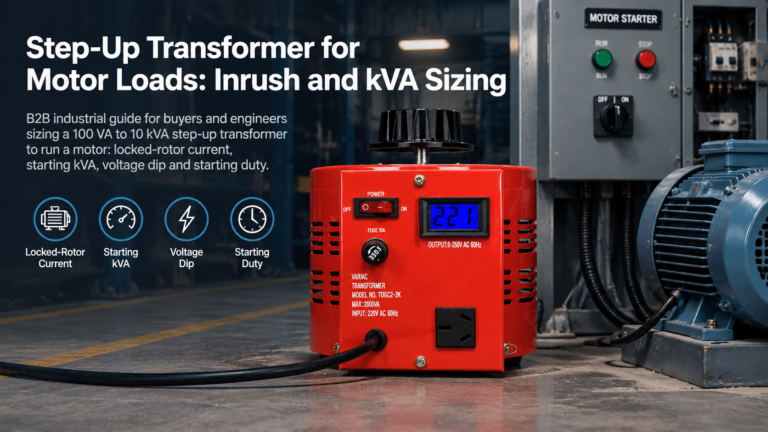
How to size a step-up transformer for a motor: locked-rotor current, kVA code letters, starting kVA by method, voltage-dip and thermal-duty checks, plus the traps most guides miss.
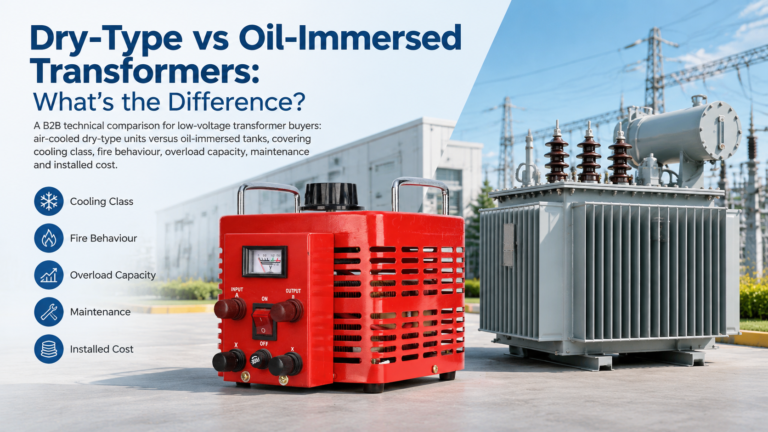
A practical dry-type vs oil-immersed transformer comparison for low-voltage buyers: cooling class, fire safety, overload, maintenance and installed cost, plus a ten-minute selection sequence.