Step Up and Down Transformer with Features and Applications
Published: Author: Johsuntech
What Is a Transformer? Basics and How They Work
Have you ever wondered how your electronic devices get the right voltage no matter where you travel or how electricity is delivered? That’s where a transformer comes in. Simply put, a transformer is an electrical device that changes voltage levels, making power safe and useful for different applications.
Core Principles of Transformers
Transformers rely on the principle of electromagnetic induction. Here’s how it works:
Primary winding: This coil receives the input voltage.
Secondary winding: This coil delivers the transformed output voltage.
Turns ratio: The number of loops (turns) in these windings determines whether voltage steps up or down.
By adjusting the turns ratio, transformers either increase voltage (step-up transformer) or decrease it (step-down transformer), while maintaining the energy balance.
Voltage and Current Relationship
One key rule is power conservation—the power in (voltage × current) equals the power out, minus minor losses. So, if voltage goes up, current decreases, and vice versa. This balance keeps electrical systems efficient and safe.
Common Transformer Types
Isolation transformers: Provide electrical separation for safety and noise reduction.
Autotransformers: Share part of the winding for a smaller, lighter design, often used for slight voltage adjustments.
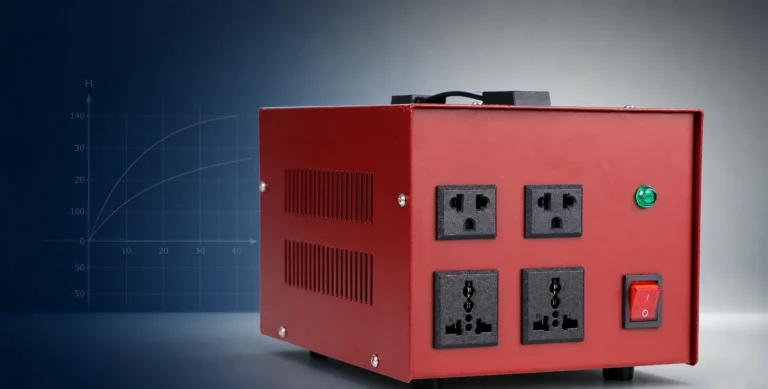
Bidirectional transformers: Designed for dual step-up and step-down use, handy for adapting equipment to different voltage standards (like a 220V to 110V converter).
Understanding these basics of transformers helps you see why they are crucial in applications ranging from power grids to household devices. Whether it’s a step-up transformer powering high-voltage lines or a step-down transformer making energy safe for your laptop charger, transformers are at the heart of reliable electricity use.
Step-Up Transformers Explained
A step-up transformer increases voltage from the primary to the secondary winding while decreasing the current proportionally. This change happens thanks to a higher number of turns on the secondary coil compared to the primary coil, following the transformer turns ratio principle. The main goal is to raise voltage levels for efficient power transmission over long distances, minimizing energy loss.
Step-up transformers are crucial in several applications:
Power Transmission: They boost voltage from power plants to tens or hundreds of kilovolts, reducing current and cutting transmission losses.
Renewable Energy Integration: Solar farms and wind turbines often use step-up transformers to match grid voltage requirements.
Industrial High-Voltage Needs: Many industries require high voltage for heavy machinery and processes, making step-up transformers essential.
The prime advantage of step-up transformers is their ability to lower current flow during transmission, which means reduced heat loss in cables and more efficient energy delivery.
For those interested in reliable voltage solutions, Johsun Tec offers a range of heavy-duty step up transformers designed for industrial and power grid applications, ensuring efficient and safe voltage increases for various needs. Check out their specialized options like the SDR Series Voltage Stabilizer to complement your power setup.
Step-Down Transformers Explained
A step-down transformer is designed to decrease voltage while increasing current on the output side. This is essential for safely powering everyday devices by reducing the high voltage from power lines to a lower, usable level. It works by having fewer turns on the secondary winding compared to the primary winding, following the transformer turns ratio principle.
Key applications for step-down transformers include:
Household appliances like microwaves, TVs, and washing machines
Electronics that require stable, lower voltages
Safe distribution of electricity from substations to residential and commercial areas
The main advantages of step-down transformers are:
Enhanced safety by providing the correct voltage level to prevent damage or hazards
Compatibility with common devices that run on lower voltages (e.g., 110V or 220V household voltage converter needs)
Ability to handle diverse load types, ensuring stable power supply
If you’re looking for reliable step-down transformer options for home or commercial use, explore custom products and solutions that meet precise wattage and voltage needs. For more technical setups, you can also check out our range of power inverters which complement transformer systems in delivering stable power.
Key Differences Between Step-Up and Step-Down Transformers
Understanding the core differences between step-up transformers and step-down transformers helps you choose the right type for your needs. Here’s a quick comparison to clarify how they differ in design, function, and application:
Feature
Step-Up Transformer
Step-Down Transformer
Purpose
Increases voltage, decreases current
Decreases voltage, increases current
Primary Winding
Fewer turns of wire
More turns of wire
Secondary Winding
More turns of wire
Fewer turns of wire
Voltage Output
Higher than input voltage
Lower than input voltage
Current Output
Lower than input current
Higher than input current
Common Use
Power transmission, industrial equipment
Household appliances, electronics
Design Consideration
Insulation for high voltage
Safety for low voltage output
Myths Debunked
Reversibility: While transformers can technically work backward, simply flipping connections does not guarantee the correct voltage or efficiency. Using the correct step-up or step-down transformer is safer and more reliable.
Efficiency: Both step-up and step-down transformers operate at similar efficiency levels if properly designed. Efficiency depends more on quality than the transformer type.
Voltage Compatibility: A transformer designed for one voltage and frequency might not work correctly under a different setup (e.g., 50Hz vs. 60Hz), so always check specs before use.
For reliable and precise voltage conversion, check out the range of step-up and step-down transformers designed to meet various power needs.
Dual Step-Up/Step-Down Transformers: The Versatile Solution
Dual step-up and step-down transformers, also known as bidirectional voltage transformers, can both increase and decrease voltage depending on the direction of power flow. For example, a common model converts 110V to 220V and vice versa, making it a practical solution for international voltage differences.
How Bidirectional Models Work
Single device with dual functionality: Switches voltage up or down without needing separate units
Turns ratio designed for reversibility: Both primary and secondary windings handle input/output interchangeably
Compact and cost-effective: Saves space and cost compared to owning multiple transformers
Benefits for Travelers, Expats, and Importers/Exporters
Ensures smooth operation of appliances from different voltage regions
Helps avoid damage from incompatible voltage levels
Supports global mobility and cross-border business operations
Real-World Uses
Scenario
Voltage Conversion
Typical Use
Using US appliances in Europe
110V to 220V
Power adapters for electronics
Running European gear in the US
220V to 110V
Protects devices from overvoltage
Import/export equipment
Voltage matching
Ensures device compatibility
Such dual transformers are ideal for household voltage converters and industrial setups that need flexibility. For reliable and durable bidirectional transformers, check out products like the UPS AF Series from Johsun Tec, which provide efficient step-up/down voltage regulation for various applications.
Explore more about our custom solutions and transformer wattage options to fit your exact power needs at Johsun Tec’s voltage stabilizer selections.
Applications in Daily Life and Industry
Step up and down transformers play a crucial role in everyday life and across industries. At home, household transformers power appliances, chargers, and entertainment systems safely by matching the device voltage to the local supply. For example, using a voltage transformer for appliances ensures your gadgets work efficiently without damage.
Travelers and people relocating abroad often rely on international voltage converters or dual voltage transformers to use their electronics where the voltage differs, such as a 220V to 110V converter or vice versa. These prevent costly equipment failures and make moving between regions hassle-free.
Industrially, step-up and step-down transformers support heavy machinery, data centers, and renewable energy installations like solar farms. Proper voltage matching allows these systems to run optimally and safely, minimizing downtime and energy loss. For large or custom power needs, heavy-duty step up down transformers offer reliable performance tailored to specific applications.
For those interested in durable options, Johsun Tec offers a wide range of transformers, including the reliable TM WMS series transformers from 3kVA to 10kVA designed for industrial and commercial use, ensuring your equipment always gets the right voltage with top efficiency.
How to Choose the Right Transformer
Picking the right step up and down transformer means matching your device’s needs precisely. Here are the main factors to consider:
Key Factors
Wattage Rating
Always choose a transformer with a wattage rating higher than your device’s power draw. Include extra margin for startup surges or motor loads—ideally 20-30% above the maximum load.
Input/Output Voltage
Confirm the transformer’s input and output voltages fit your source and device. For example, selecting between 110V and 220V or a dual voltage transformer depending on your application.
Frequency Compatibility
Check if your devices work at 50Hz or 60Hz. Mismatched frequency can cause overheating or poor performance.
Load Type
Resistive loads (heaters, lamps) are straightforward and steady.
Inductive loads (motors, transformers) need extra capacity and should consider inrush currents.
Sizing Guide at a Glance
Load Type
Wattage Calculation
Notes
Resistive
Use device wattage + 20% margin
Simple, consistent load
Inductive
Use device wattage + 30-40% margin
Account for startup surges
Mixed Loads
Calculate separately + safety margin
Sum and add 30% total margin
Essential Safety Features
Fuse Protection: Prevents damage from overload or short circuits.
Thermal Overload: Shuts down the transformer if it overheats.
Grounding: Avoids electric shock and protects your equipment.
Johsun Tec Recommendations
Johsun Tec offers both custom transformers and standard models designed for reliable, efficient performance. Whether you need a heavy duty step up down transformer or a compact household voltage converter, their solutions cover:
Choosing the right transformer means balancing power needs, safety, and voltage compatibility for smooth, trouble-free operation every time.
Safety Tips and Best Practices for Step-Up and Step-Down Transformers
Using step-up and step-down transformers safely is key to protecting your appliances and ensuring long-lasting performance. Here are some essential tips to keep in mind:
Avoid Overloads: Always choose a transformer with a wattage rating higher than your device’s power needs. Overloading the transformer can cause overheating and damage both the transformer and your appliances.
Ensure Proper Grounding: Grounding helps prevent electrical shocks and equipment damage. Make sure your transformer is correctly grounded according to local electrical codes to boost safety and performance.
Maintain Good Ventilation: Transformers generate heat while operating. Keep your voltage transformer for appliances in a well-ventilated area to avoid overheating and reduce the risk of failure.
Use Correct Voltage and Frequency: Match the transformer’s input and output voltage and frequency specifications (50Hz vs. 60Hz) to your device’s requirements to avoid malfunction.
Fuse Protection and Thermal Overload: Choose transformers equipped with built-in fuse protection and thermal overload safeguards for added security.
Regular Inspections: Check cables and connectors frequently for wear or damage to prevent short circuits or performance drops.
Common mistakes include using undersized transformers or plugging in incompatible devices, which lead to blown fuses or appliance damage. Following these basic precautions will ensure your step-up and step-down transformer operates efficiently and safely for years.
When it comes to step up and down transformers, Johsun Tec stands out for quality and customization. We specialize in creating durable, efficient transformers tailored for both household use and custom industrial needs. Whether you need a heavy duty step up down transformer or a compact household voltage converter, our products are designed to deliver reliable performance every time.
What Sets Johsun Tec Apart?
Feature
Benefit
Custom Transformers
Exact specs for your voltage and wattage needs
High Efficiency Design
Lower energy loss, saving you money over time
Wide Product Range
From small 110V to 220V converters to large power transformers
Safety Certified
IC certification on key series ensures safety and durability
Expert Support
Guidance on transformer wattage calculation and selection
With extensive expertise in custom voltage transformers and proven success in international applications, Johsun Tec ensures you get the best fit for your project. Our step-up and step-down transformer TC THG series is a prime example of balancing power, safety, and longevity in one package.
Choose Johsun Tec for transformers that meet global standards and keep your devices running smoothly—whether at home, industry, or travel. For more details on selecting the right transformer, check out our detailed guide on selecting the right low voltage transformer for your industrial needs.
Transformer core saturation happens when the core can no longer absorb more magnetic flux. Learn the causes, symptoms, a simple no-load test and prevention for 100 VA-10 kVA dry-type transformers.
How a buck-boost transformer works: series-winding polarity, differential kVA sizing with single-phase and three-phase examples, and the five limits that decide when it is the wrong tool.
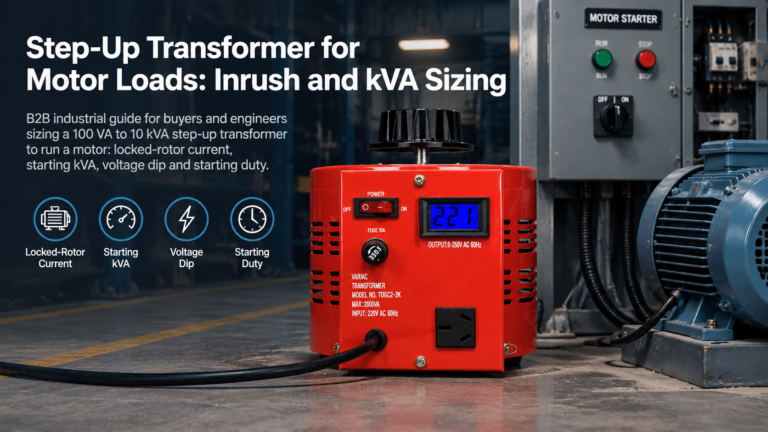
How to size a step-up transformer for a motor: locked-rotor current, kVA code letters, starting kVA by method, voltage-dip and thermal-duty checks, plus the traps most guides miss.